
SEO is changing, and the way we used to approach it a few years ago may not give us the same results today.
If you work in SEO or digital marketing, you’ve probably noticed that ranking on Google’s first page doesn’t always bring the traffic you expect. Sometimes, your rankings remain stable, but your clicks start dropping.
Why does this happen?
One of the biggest reasons is how people now interact with search engines. With Google’s AI Overviews and AI tools like ChatGPT becoming more popular, users can find answers without visiting a website.
But that’s not the only change happening in SEO.
I came across some interesting research from Pew Research Center, the Reuters Institute, Google, and StatCounter. Some of these findings might surprise you, especially if you’re still following traditional SEO strategies.
In this post, I’ll share 10 SEO marketing shocking facts, explain what they mean, and discuss how you can adjust your SEO strategy accordingly.
How much of your traffic is exposed to Google AI Overviews?
Enter your numbers from Google Search Console. The calculator applies the Pew Research and Reuters Institute data from this post to estimate how many clicks AI summaries could cost you and what to fix first.
Your site
Search Console → Performance → last 28 days → Total clicks.
These three add up to more than 100%. Lower one of them.
GA4 → Reports → Acquisition → Traffic acquisition.
Your estimate
Fix these first
How it works: AI summary rates per query type come from Pew Research Center (8% of 1–2 word searches, 53% of 10+ word searches, 60% of who/what/when/why searches, 18% of all searches for the rest). When a summary appears, clicks fell from 15% to 8% of visits, a 47% relative drop. This is a directional estimate, not a forecast for your site.
Let’s get started.
1. AI Overviews Can Reduce Website Clicks by Almost Half
We all know that ranking higher on Google helps websites attract organic traffic. But what happens when Google answers a user’s question directly in the search results?
According to a Pew Research Center study, researchers analysed 68,879 Google searches made by 900 US adults in March 2025.
Here’s what they found:
- When Google displayed an AI summary, users clicked traditional search results in only 8% of visits.
- When there was no AI summary, users clicked traditional search results in 15% of visits.
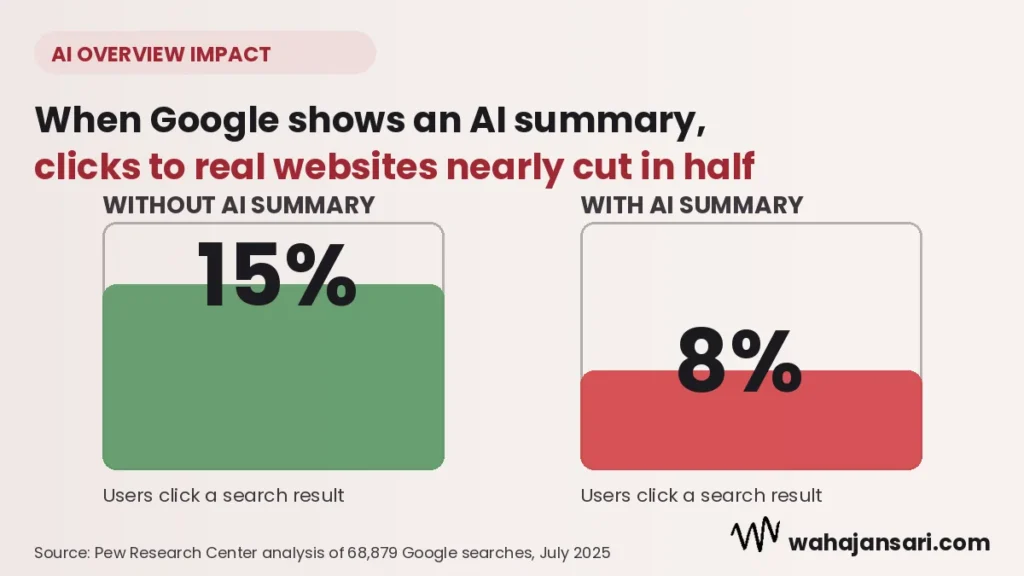
That’s a significant difference.
Think about it. You’ve spent months optimising a blog post, building backlinks, and improving its rankings. Finally, your page reaches the first position on Google.
But instead of clicking your website, users read the AI-generated answer and move on.
Your page may still rank well, but you might not receive the traffic you expected.
What Should SEO Professionals Do?
I don’t think we should stop focusing on Google rankings. They are still important, but we need to change how we measure success.
Instead of targeting keywords just because they have high search volume, focus on topics that encourage users to visit your website.
For example, if someone searches for “What is SEO?”, Google can easily explain the answer in an AI Overview.
But if someone searches for “SEO audit checklist for an eCommerce website”, they may need a detailed checklist or practical resource.
The goal is to create content that offers something useful beyond a basic answer.
2. Only 1% of Users Click Links Inside AI Overviews
Many SEO professionals are now focusing on getting their websites mentioned in Google’s AI Overviews.
The idea seems simple. If Google uses your content as a source, more people will discover your website.
But here’s something interesting.
The same Pew Research Center study found that users clicked a link within an AI summary in only 1% of visits where an AI summary appeared.
That means appearing as a source in an AI Overview doesn’t necessarily bring a large amount of traffic.
So, is it worth optimising your content for AI Overviews?
I believe it is, but we need to understand the purpose.
Being mentioned in AI-generated answers can help improve your brand’s visibility. People may become familiar with your business even if they don’t visit your website immediately.
However, visibility and traffic are two different things.
What Should You Focus On?
My suggestion is to focus on topics relevant to your business rather than trying to get mentioned in every possible AI Overview.
Let’s take an example.
Suppose you run an SEO agency.
Getting mentioned in an AI answer about “What does SEO mean?” might increase brand awareness.
But appearing in an answer about “How to choose an SEO agency for an eCommerce business?” could introduce your brand to someone who is actually looking for a service.
Both have value, but the second is more closely connected to your business goals.
The important thing is to build visibility where your potential customers are searching.
3. Around 26% of Searches With AI Summaries End the Browsing Session
Here’s another interesting finding from the same research.
Pew Research Center found that 26% of search visits with an AI summary ended the user’s browsing session.
For searches without an AI summary, the figure was 16%.
In simple words, users were more likely to stop browsing after seeing an AI-generated answer.
Let’s understand this with an example.
Imagine someone searching for “How long does SEO take to show results?”
Previously, they might have opened two or three websites to understand the answer.
Now, Google can display a summary explaining that SEO results depend on factors such as competition, website authority, and the work involved.
If that information answers their question, they might not visit any website.
For businesses that depend on informational blog traffic, this creates a challenge.
You could have useful content, good rankings, and strong impressions, but fewer people may visit your website.
Does This Mean Organic Traffic Is No Longer Important?
Not at all.
Organic traffic is still an important SEO metric. However, relying only on traffic numbers may not give you the complete picture.
You should also monitor:
- Branded search impressions and clicks
- Direct website traffic
- Leads generated through organic search
- Contact form submissions and phone calls
- Email signups
- Conversions from important landing pages
For example, if your blog traffic decreases but your branded searches and enquiries increase, your SEO efforts may still be helping your business.
The key is to focus on business results rather than traffic alone.
4. Around 60% of Question-Based Searches Trigger AI Summaries
When doing keyword research, SEO professionals often look for question-based keywords.
These include searches such as:
- What is technical SEO?
- How does keyword research work?
- Why is my website not ranking?
- When should I update old blog posts?
These keywords are useful because they help us understand what people want to know.
But AI Overviews have changed how Google handles many of these questions.
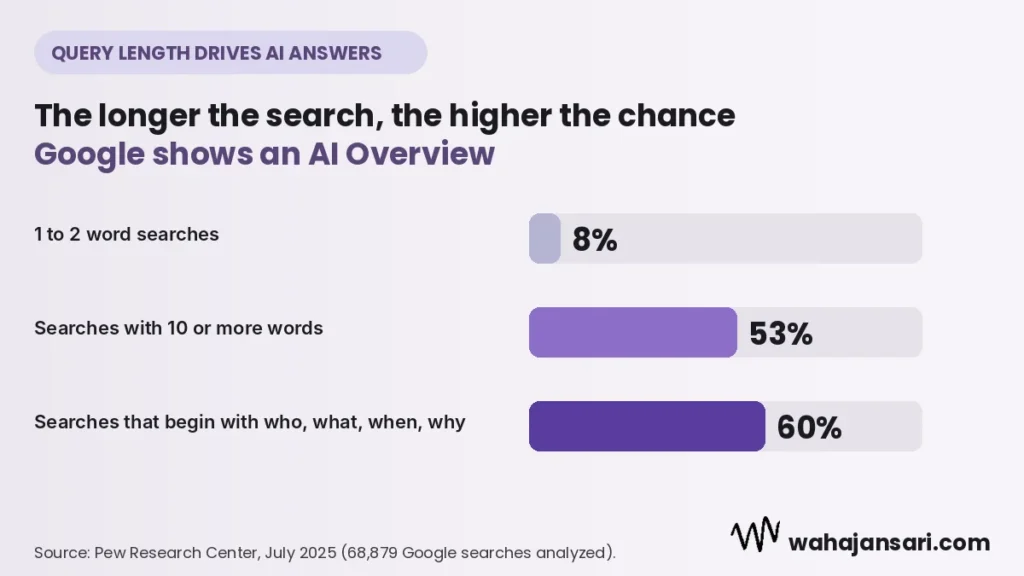
According to Pew Research Center:
- Only 8% of searches containing one or two words produced an AI summary.
- Around 53% of searches containing 10 or more words produced an AI summary.
- Around 60% of searches beginning with words such as “who”, “what”, “when”, or “why” produced an AI summary.
This tells us something important.
Long, question-based keywords are more likely to trigger AI summaries than short searches.
How Should You Approach Informational Content?
I wouldn’t recommend avoiding question-based keywords completely.
They are still valuable, especially when you want to build topical authority and help users understand your services.
However, you should focus on making your content more useful.
For example, let’s say you’re writing a blog post about “How to do keyword research for SEO”.
Instead of providing only a basic definition and a few general tips, you can include:
- A simple explanation of keyword research
- A step-by-step process
- Real keyword examples
- Screenshots from SEO tools
- Common mistakes beginners should avoid
Google’s AI Overview may summarise the basic steps, but readers who want to apply the process might still visit your website.
That’s the type of content I believe we should focus on.
5. Google Organic Traffic to News Publishers Dropped 33% Globally
For years, publishers and businesses have relied on Google to bring visitors to their websites.
But recent research shows that this traffic is becoming less predictable.
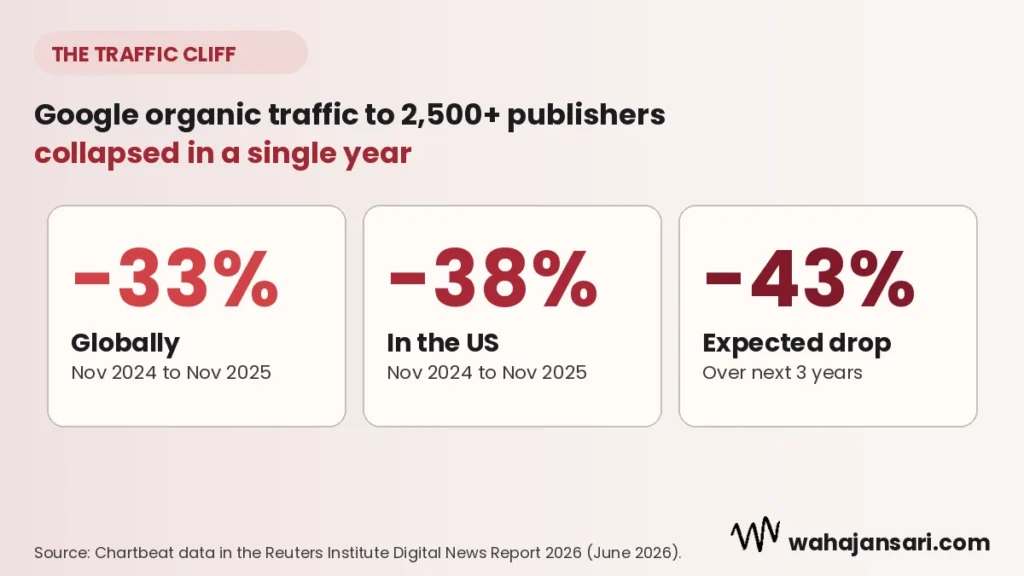
According to the Reuters Institute Digital News Report, Chartbeat analysed traffic data from more than 2,500 news websites.
The findings showed that Google organic search traffic to these websites declined by:
- 33% globally
- 38% in the United States
The comparison covered November 2024 to November 2025.
That’s a major traffic drop in just one year.
Now, it’s important to understand that this research focuses on news publishers, not every type of website.
However, it still highlights a problem that businesses should consider.
If most of your website traffic comes from informational content, changes in search behaviour could affect your visitors and potential leads.
What Can Businesses Learn From This?
Let’s say you run a small digital marketing agency and publish 10 blog posts every month.
Your goal is to attract visitors through informational keywords and convert some of them into customers.
But if people start getting those answers directly from Google, your blog posts may receive fewer clicks.
Does that mean you should stop blogging?
No. Instead, you should rethink your content strategy.
I’ve spent a chunk of my career working on local plumbing sites, and this exact pattern killed one of them. The owner was publishing a new “10 signs of a leak” style blog post every two weeks. None of them had internal links from the service pages. None had been pitched for a single backlink. Six months in, Search Console looked like a flat line. The fix wasn’t more content. We stopped new posts for a quarter, pointed the service pages at the five best blogs with real anchor text, and rebuilt the two posts that had any traction at all. The flat line started moving by month two.
Along with informational blog posts, focus on content that supports your business goals.
This could include service pages, case studies, comparison articles, and practical guides.
You should also consider bringing visitors from other sources, such as social media, email newsletters, and YouTube.
Depending on Google alone can be risky, especially when search behaviour is changing.
6. Publishers Expect Search Traffic to Drop Another 43% by 2029
The previous fact was about traffic that publishers have already lost.
But what about the future?
According to the Reuters Institute Digital News Report, surveyed publishers expect search engine traffic to decline by another 43% over the next three years.
Keep in mind that this is a forecast based on publisher expectations, not a confirmed future result.
Still, it shows how seriously the publishing industry is taking changes in search.
If this prediction comes close to reality, businesses that rely entirely on organic search may need to rethink how they attract customers.
Why Having Multiple Traffic Sources Matters
I like to think of it this way.
Imagine running a shop where all your customers come through one entrance.
Everything works well until that entrance becomes difficult to access.
Now you’re left with fewer visitors because you never created another way for customers to reach you.
The same thing can happen with your website.
If Google is your only traffic source, any major change in search can affect your business.
That’s why building an audience outside Google is important.
For example, you can:
- Build an email list to stay connected with readers.
- Share useful content on LinkedIn or other relevant platforms.
- Create YouTube videos around topics your audience searches for.
- Develop a brand that people recognise and search for directly.
SEO should remain part of your marketing strategy, but it shouldn’t be the only channel you depend on.
7. Around 15% of Google Searches Are Completely New
Here’s one of the most interesting SEO facts.
According to Google, around 15% of the searches it sees every day are queries it hasn’t seen before.
That means roughly one out of every seven searches is new to Google.
Now, think about how we normally approach keyword research.
We open tools like Ahrefs or Semrush, enter a seed keyword, check the search volume, analyse keyword difficulty, and shortlist the keywords we want to target.
There’s nothing wrong with that approach.
But keyword research tools can’t predict every new question someone might search for.
People use different words, phrases, and sentence structures to describe the same problem.
Why You Should Focus on Topics, Not Just Keywords
Let’s take a simple example.
Suppose you’re creating a blog post about “How to improve website speed”.
Your primary keyword might have a specific search volume, but people could search for the same topic using different phrases.
For example:
- Why is my WordPress website loading slowly?
- How can I make my website faster on mobile?
- What causes slow page loading?
- How do I reduce website loading time?
Instead of creating separate pages for every small variation, you can cover relevant questions naturally within one detailed guide.
This helps users find complete information without visiting multiple pages.
It can also help your website appear for relevant long-tail searches that weren’t part of your original keyword list.
My advice is simple: use keyword research tools to understand demand, but don’t limit your content to the exact keywords those tools suggest.
8. Google Still Dominates Search, While Mobile Accounts for Around 60% of Web Usage
With all the discussion around AI search, you might think Google is losing its importance.
But Google still holds approximately 90% of the global search engine market, according to Wikipedia’s Google Search entry, which draws on StatCounter data.
Another important figure comes from StatCounter.
Its September 2026 platform market-share data showed mobile accounting for around 60%, compared with approximately 40% for desktop.
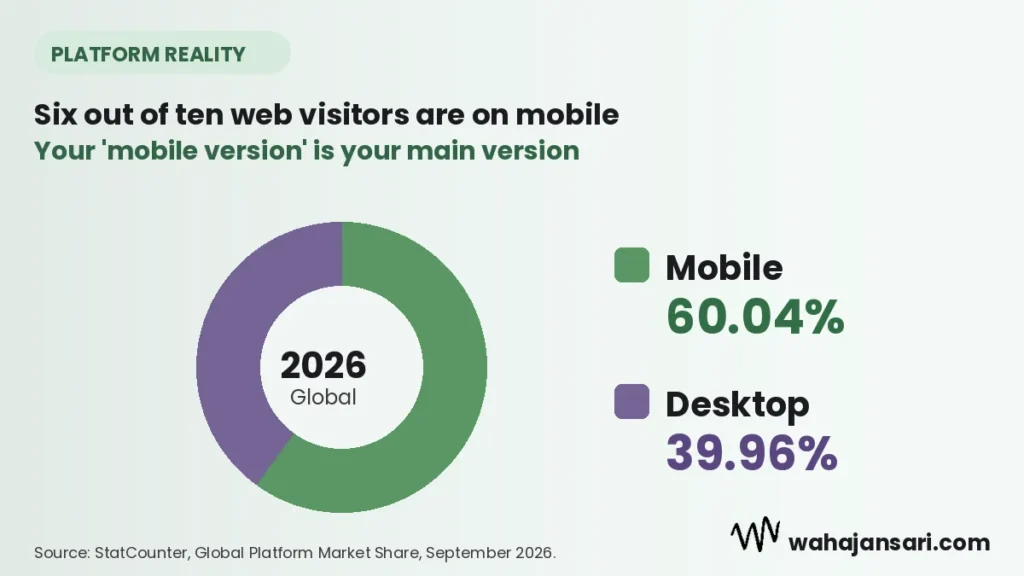
These figures tell us two important things.
First, Google is still a major platform for reaching potential customers.
Second, mobile users represent a large portion of internet activity.
Despite this, many businesses still focus more on how their websites look and perform on desktop.
Why Mobile SEO Should Be a Priority
Imagine someone searching for a service on their phone.
They find your website on Google, click the result, and land on your page.
But the website takes too long to load. The images are too large, the buttons are difficult to click, and the content doesn’t fit properly on the screen.
What do you think they’ll do?
Most likely, they’ll leave and try another website.
Even if your website ranks well, a poor mobile experience can make it difficult to convert visitors into customers.
What Should You Check?
Start by opening your website on a mobile phone and reviewing its performance.
Pay attention to:
- How quickly the page loads
- Whether the text is easy to read
- Whether buttons and menus work properly
- Whether images fit the screen
- Whether users can easily find important information
You can also use Chrome DevTools or Google’s PageSpeed Insights to identify performance issues.
Mobile optimisation is not just about making your website responsive. It’s about providing a good experience to people who actually use it.
9. Around 34% of US Adults Have Used ChatGPT
AI tools are no longer something only developers or technology enthusiasts use.
They’re becoming part of everyday life.
According to a Pew Research Center study published in June 2025, 34% of US adults reported using ChatGPT.
That’s approximately twice the share reported in 2023.
Among adults under the age of 30, the figure was even higher at 58%.
So, what does this have to do with SEO?
Let’s understand it with an example.
Previously, someone looking for the best SEO tools might have searched Google, opened a few comparison articles, and shortlisted the options.
Now, they might ask ChatGPT:
“What are the best SEO tools for a small business with a limited budget?”
Instead of reviewing several search results, they receive a response with suggestions and explanations.
This creates another opportunity for businesses to improve their visibility.
Should You Start Optimising for AI Search?
I believe it’s worth paying attention to AI search, especially if your audience uses tools like ChatGPT, Gemini, Claude, or Perplexity.
You may have heard terms such as Answer Engine Optimisation (AEO) or Generative Engine Optimisation (GEO).
These approaches focus on improving how content and brands appear in AI-powered answers.
However, this doesn’t mean you need to abandon traditional SEO.
Many useful practices are still similar:
- Create helpful and accurate content.
- Answer important questions clearly.
- Organise your pages using relevant headings.
- Build a trustworthy online presence.
- Keep your website information consistent and updated.
The important thing is to make your content useful for both people and search systems.
And remember, being recommended by an AI tool is not guaranteed, even when your website follows these practices.
10. AI Chatbot Usage for News Has Increased From 7% to 10%
Here’s the last fact, and I think it’s worth paying attention to.
According to the Reuters Institute Digital News Report, the percentage of people using AI chatbots as a source of news increased from 7% to 10% within a year.
At first, 10% might not sound like a large number.
But the interesting part is the direction in which things are moving.
More people are becoming comfortable using AI tools to discover and understand information.
The report also highlights changing news consumption habits among younger audiences.
Now, this doesn’t mean AI chatbots will replace Google or traditional news websites.
It simply shows that people are starting to use different platforms to access information.
What Does This Mean for Digital Marketers?
I think the biggest lesson here is that we shouldn’t depend on one platform or one way of reaching our audience.
Search behaviour will continue to evolve.
Some people will use Google. Others will use AI chatbots, YouTube, social media, or different sources depending on what they’re looking for.
As marketers, our job is to understand where our target audience spends time and how they discover information.
For example, if your potential customers regularly use AI tools to compare products or services, improving your brand’s presence across trustworthy sources may become increasingly valuable.
But if most of your customers still discover businesses through Google Search, traditional SEO should remain a major priority.
The right approach depends on your audience and business goals.
Final Thoughts: What These SEO Facts Mean
After reviewing these 10 SEO marketing facts, one thing becomes clear to me.
SEO isn’t disappearing, but the way people search and interact with content is changing.
A few years ago, many SEO strategies focused heavily on keywords, rankings, and organic traffic.
Those things are still important, but they’re no longer enough on their own.
Today, we also need to consider how AI Overviews affect clicks, how people use AI chatbots, and whether our content provides enough value for someone to visit our website.
If you’re working on SEO, here’s what I’d recommend:
- Focus on search intent: Choose keywords that match what your target audience actually needs.
- Improve your existing content: Add useful examples, detailed explanations, and practical information instead of publishing new posts just to increase your content count.
- Track meaningful results: Monitor leads, conversions, branded searches, and other business metrics alongside organic traffic.
- Pay attention to AI search: Understand how AI-powered platforms are changing the way people discover brands.
- Build more than one traffic source: Don’t depend entirely on Google to attract visitors and customers.
- Improve the mobile experience: Make sure your website works properly for the people accessing it on their phones.
One thing I’ve always believed about SEO is that long-term results come from understanding your audience and continuously improving your website.
You don’t need to change your entire strategy every time Google introduces something new.
But you do need to understand what’s changing and adjust your approach when necessary.
The goal isn’t just to rank higher on Google. It’s to make sure the right people can find your business, trust your content, and take action.
That’s what makes an SEO strategy valuable in the long run.
Discover more from Wahaj Ansari
Subscribe to get the latest posts sent to your email.