
You finally land a link from a big, well-known site. Then you check the code, spot rel=“nofollow”, and it feels like getting a gift card with a zero balance. Sound familiar? Before you write that link off, let’s look at what it’s actually doing for you.
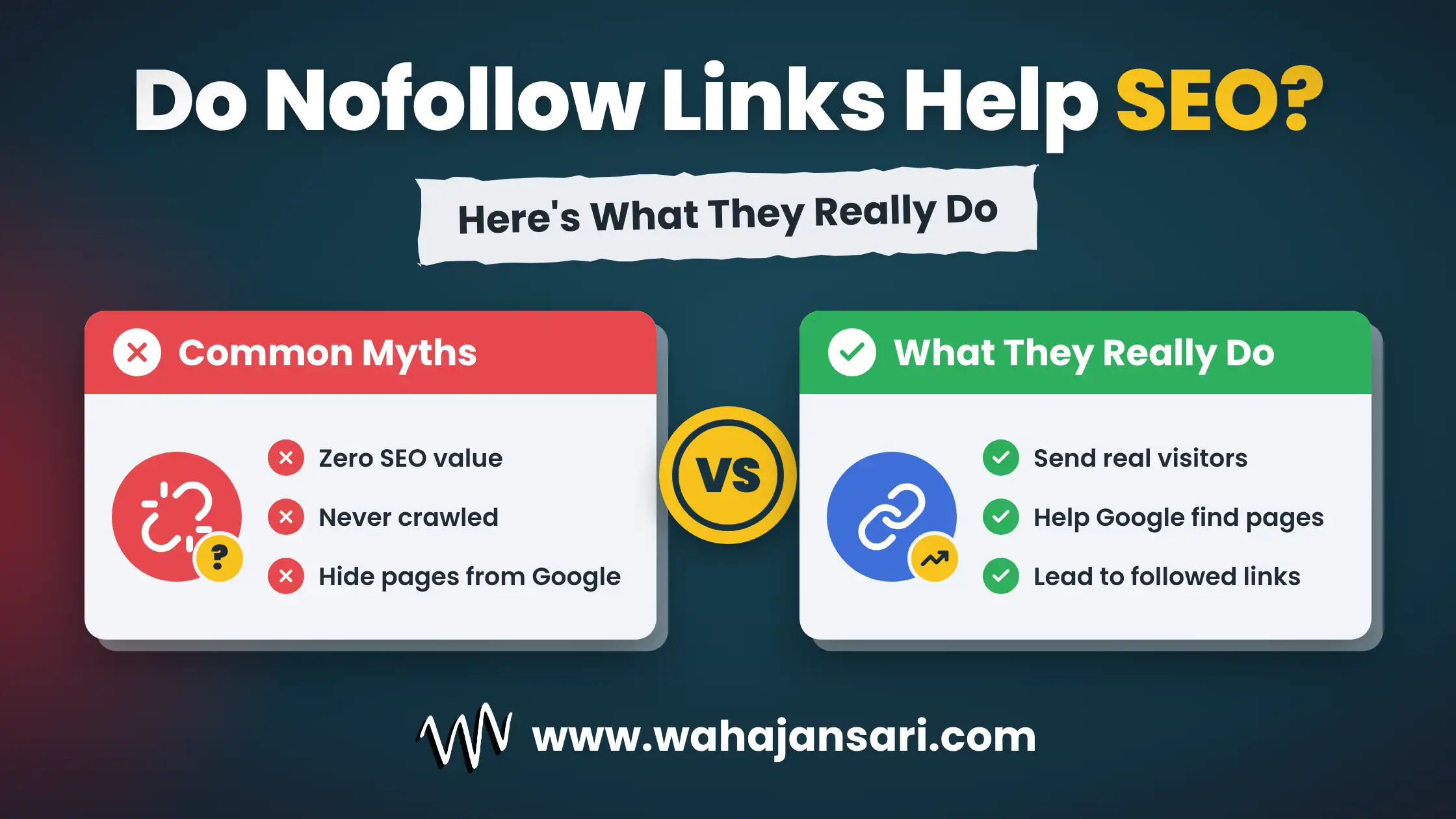
So, do nofollow links help SEO? Yes, but mostly indirectly. A nofollow link usually doesn’t pass PageRank, so it won’t push your rankings the way a followed link can. Since 2019, though, Google has treated nofollow as a hint, and nofollow links can still bring traffic, help Google discover your pages, and lead to followed links later.
Now you might be wondering: are nofollow links good for SEO at all, or just filler in your backlink report? Let’s break down what Google actually says, which ones deserve your time, and how to use nofollow on your own site without shooting yourself in the foot.
Free tool
Nofollow Link Checker
Find out if a link is worth chasing, or which rel attribute to use on your own site.
Answer five quick questions about a link you have, or one you’re thinking of chasing.
Adding a link to your own site? Pick what kind it is and get the right attribute plus a snippet you can copy.
Results follow the checks and Google guidance covered in this post. Treat them as a guide, not a guarantee.
Do Nofollow Links Help SEO Rankings Directly?
Usually, no. When Google announced its 2019 change to nofollow, it said that in most cases it would keep treating these links as before: not counting them for ranking. So if you’re asking “do nofollow links pass link juice?”, the honest answer is that most of them don’t.
Link juice is just SEO slang for PageRank, the ranking credit one page passes to another through a link. I like to think of a nofollow link as a friend who gives someone your number and says, “I’m not vouching for this guy.” You still get the call. You just don’t get the reference.
But here’s the twist: Google said “in most cases,” not “always.” Since September 10, 2019, it has treated nofollow as a hint it can weigh alongside other signals, because links carry useful information, like how the words in a link describe the page they point to. So Google can decide a nofollow link counts for something, and nobody outside Google knows exactly when.
Here’s how I’d play it: assume a nofollow link passes nothing, and treat any ranking boost as a bonus. Then build your plan around what nofollow links reliably do, which is the part most people ignore.
Dofollow vs Nofollow Links: What’s Actually Different?
When you compare dofollow vs nofollow links, the whole difference comes down to one small piece of code. A nofollow link has rel=“nofollow” inside the link tag, while a “dofollow” link is just a normal link with no attribute at all. That one attribute is the reason this whole “do nofollow links help SEO” debate exists.
Fun fact: there’s no such thing as a dofollow tag. It’s SEO slang for a link nobody added an attribute to, and Google’s own documentation says regular links don’t need a rel value. To a visitor, both links look and work exactly the same.
The differences only show up behind the scenes. Side by side, it looks like this:
| Normal (“dofollow”) link | Nofollow link | |
|---|---|---|
| The code | <a href=”url”> | <a href=”url” rel=”nofollow”> |
| Passes ranking credit | Yes, it can | Usually not |
| Google can crawl it | Yes | Sometimes, since it’s a hint |
| Sends visitors | Yes | Yes |
| Best for | Sources you trust and chose to link | Links you don’t want to vouch for |
Nofollow also got two siblings in 2019: rel=“sponsored” for paid links and rel=“ugc” for links your users post, like comments. All three work as hints, and I’ll show you when to use each one further down.
How Do Nofollow Links Help SEO Without Passing PageRank?
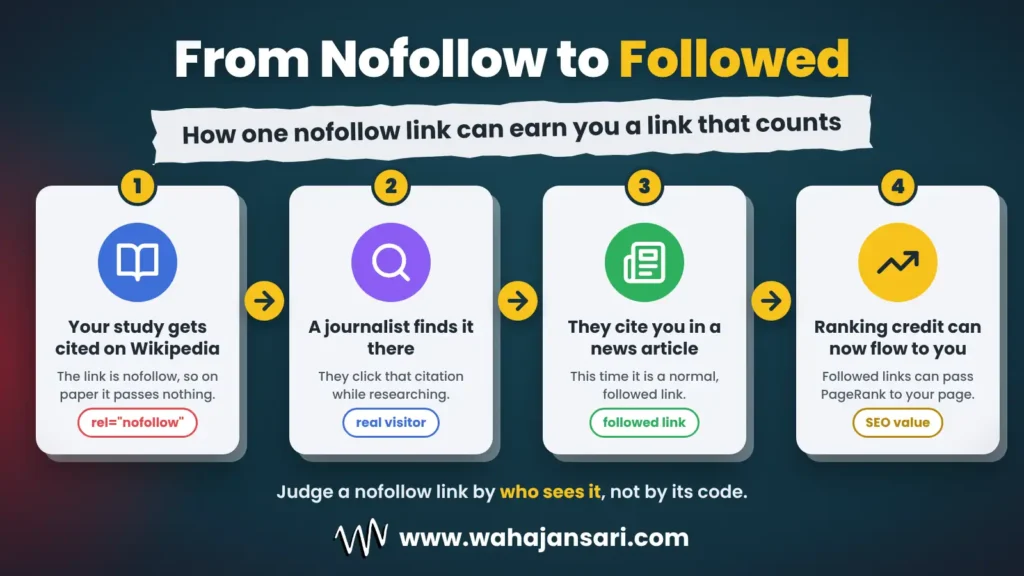
They help through what happens after people see the link. That’s where the real nofollow links SEO benefits live: in the visitors, crawls and followed links it leads to, not in the link itself. Let me give you an example.
Say your original study gets cited on Wikipedia. That link is nofollow (English Wikipedia has nofollowed its external links since 2007), so on paper it passes nothing. But a journalist finds your study through that citation and links to it from a news article with a normal link. One nofollow link just earned you a followed one.
That chain reaction is the whole game. A good nofollow link can do four things for you:
- It sends real visitors. People click links on pages they actually read, and those clicks can turn into leads or sales with zero PageRank involved.
- It can help Google find your pages. Google uses links to discover new pages to crawl, and since 2020 it can choose to follow a nofollow link.
- It leads to followed links. People who find you through one can cite you on their own sites, like that journalist.
- It puts your name in front of the right crowd. A mention on a trusted site in your niche gets seen, and some of those readers will look you up later.
You’ll also hear that you need nofollow links so your backlink profile “looks natural.” I’d take that one with a pinch of salt. Google doesn’t publish any ideal ratio of followed to nofollow links, and chasing one is a waste of time. Earn links from real places and a natural mix shows up on its own.
Which Nofollow Backlinks Are Worth Getting?
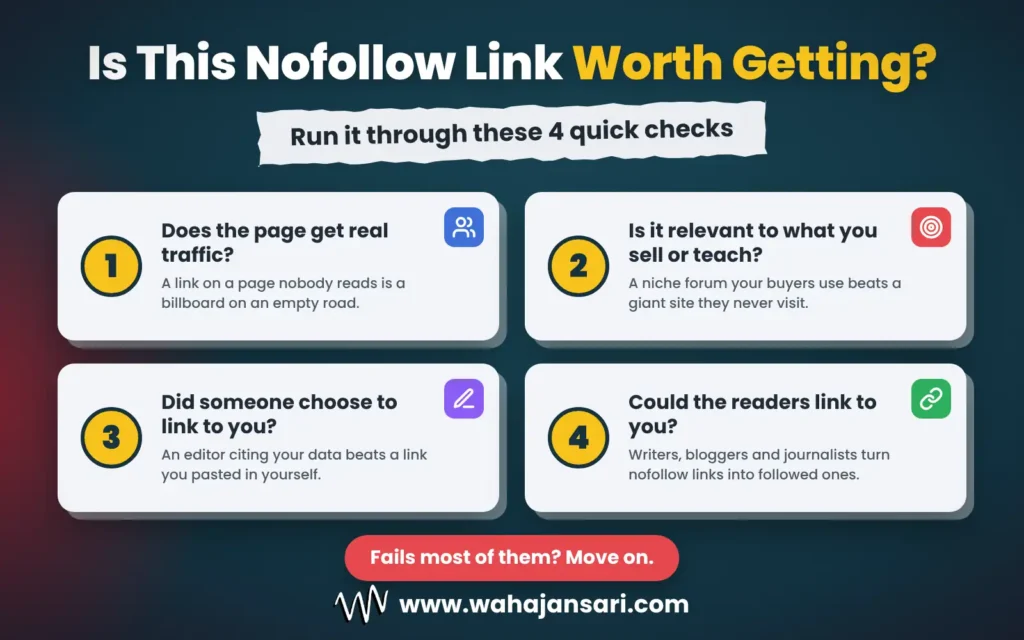
Do nofollow backlinks have SEO value if nobody ever clicks them? Honestly, very little. A nofollow link is only worth chasing when real people see it, so judge it by its audience, not its code.
Before you spend an hour going after one, run it through these four checks. If it fails most of them, move on:
- Does the page get real traffic? A nofollow link on a page nobody reads is a billboard on an empty road.
- Is it relevant to what you sell or teach? A niche forum your buyers actually use beats a giant site they never visit.
- Did someone choose to link to you? An editor citing your data beats a link you pasted into a comment box yourself.
- Could the readers link to you? Pages read by writers, bloggers and journalists are where nofollow links turn into followed ones.
Now for what to skip. Google’s spam policies list forum comments with optimized links and low-quality directory links as examples of link spam, so dropping your URL into comment sections is a wasted afternoon at best. Get links that pass the four checks above, and you’ll never need to Google “do nofollow links help SEO” again.
Does Google Crawl Nofollow Links?
Sometimes, and this is where a lot of older guides are out of date. Since March 1, 2020, Google has treated nofollow as a hint for crawling and indexing too, not just for ranking. Its guidance on qualifying outbound links says these links generally won’t be followed, but the linked page can still get crawled if Google finds it another way, like through your sitemap.
This is where a lot of site owners trip up. Say you nofollow every link to your thank-you page to keep it out of Google, but the page also sits in your sitemap. Google can find it anyway, and your nofollow did nothing.
So don’t use nofollow as a hiding tool. If you want a page out of search results, use a noindex tag, and if you want to stop Google crawling pages on your own site, Google points you to a robots.txt disallow rule. Just don’t do both on the same page, because if robots.txt blocks the page, Google can’t see the noindex tag.
I once had a client who was genuinely upset after discovering that most of the backlinks we had acquired were nofollow. His reaction was something like, “Wahaj, did we just spend money getting links that Google completely ignores?” I had to explain that not every backlink needs to pass PageRank to be valuable. But instead of arguing with him, I decided to show him how these links could contribute to the bigger SEO picture.
My responsibility was to evaluate the existing backlinks and identify opportunities worth pursuing. I used Ahrefs to analyze referring domains, Google Analytics 4 to monitor referral traffic, and Google Search Console to observe organic search performance. I noticed that some nofollow links were coming from relevant industry websites with actual audiences, while several supposedly valuable backlinks were sitting on websites that looked busier than a ghost town.
I changed our link-building approach. Instead of chasing websites simply because they offered dofollow links, I focused on relevant publications, niche communities, and websites where potential customers actually spent time. I also worked on getting the client’s content mentioned naturally in industry discussions. The idea was simple: earn visibility first, and let valuable links follow naturally.
The interesting part? Some of those nofollow mentions started bringing referral visitors and creating additional opportunities for organic backlinks. We didn’t suddenly jump to position one overnight, but we built a more meaningful backlink acquisition strategy. My biggest takeaway was simple: I’d rather get a nofollow link from a website people actually visit than a dofollow link from a website even its owner has forgotten about.
How to Use Nofollow, Sponsored and UGC on Your Own Site
So far we’ve answered “do nofollow links help SEO” for links pointing at you. Now flip it around. My rule of thumb for your own site is simple: label a link only when there’s a reason to, and leave normal editorial links alone.
Each attribute has its own job. You can also combine values, like rel=“ugc nofollow”, when a link fits more than one bucket:
- rel=“sponsored” for ads, paid placements and affiliate links. Google prefers sponsored for paid links, but nofollow is still accepted.
- rel=“ugc” for links your users add, like blog comments and forum posts.
- rel=“nofollow” for links you don’t want to vouch for when the other two don’t fit.
- No attribute for every normal link to a source you trust.
The mistake I’d fix first is the blanket nofollow. Some sites slap nofollow on every external link out of fear, but Google’s link best practices say to “use nofollow only when you don’t trust the source.” Linking out to good sources is normal, and the same page says it can actually build trust with your readers.
The second one is not following your own internal links to push more value toward important pages. It’s a leftover habit from the old PageRank sculpting days, and it can make it harder for Google to discover pages you actually want found. Link to your own pages normally and let your site structure do the work.
FAQs
Can nofollow links hurt your SEO?
No, a normal nofollow link pointing to your site isn’t a threat. Google generally doesn’t count nofollow links for ranking, so a random one on a low-quality page won’t drag you down. If anything, the bigger risk is wasting hours building them in bulk from places nobody reads.
Do nofollow links help SEO for a new website?
Yes, and arguably more than for an established site. A brand-new site has few links of any kind, so a nofollow mention in a relevant community can bring its first visitors and give Google another path to its pages. Just don’t expect those links alone to lift your rankings, because you’ll still need followed links over time.
How do you check if a link is nofollow?
Right-click the link in your browser, choose Inspect, and look for a rel attribute inside the <a> tag. If you see nofollow, sponsored, or ugc, the link is qualified, and no rel value means it’s a normal link. Inspect beats View Source here, because it also shows attributes added by JavaScript. For hundreds of links at once, a site crawler or backlink tool will flag them for you.
What happens if you use the wrong link attribute?
Mostly nothing, so relax. Google’s 2019 FAQ says there’s no wrong attribute except with sponsored links, and the worst case of marking a normal link as sponsored is that Google might not count it as credit for the other site. The mistake that actually matters is the reverse: leaving a paid link without sponsored or nofollow.
Do nofollow links matter for AI search?
I haven’t seen any AI company publish how its tools weigh nofollow versus followed links, so be careful with anyone who claims to know. My take is simple: these tools read the words on a page, and a mention of your brand on a trusted site is still there whether the link is nofollow or not. That’s one more reason to judge a link by where it sits and who reads it.
Final Thoughts
So, do nofollow links help SEO? Not the way a followed link does, and that’s fine. The best nofollow links bring visitors, get your name in front of the right people, and quietly lead to the followed links that do move rankings.
Here’s the test I’d run before chasing any link: would you still want it if Google didn’t exist? If the answer is yes because real people will see it and click, go get it, nofollow or not. If the only reason you want it is a bigger backlink count, skip it and spend that hour making something people will actually link to.
Discover more from Wahaj Ansari
Subscribe to get the latest posts sent to your email.