
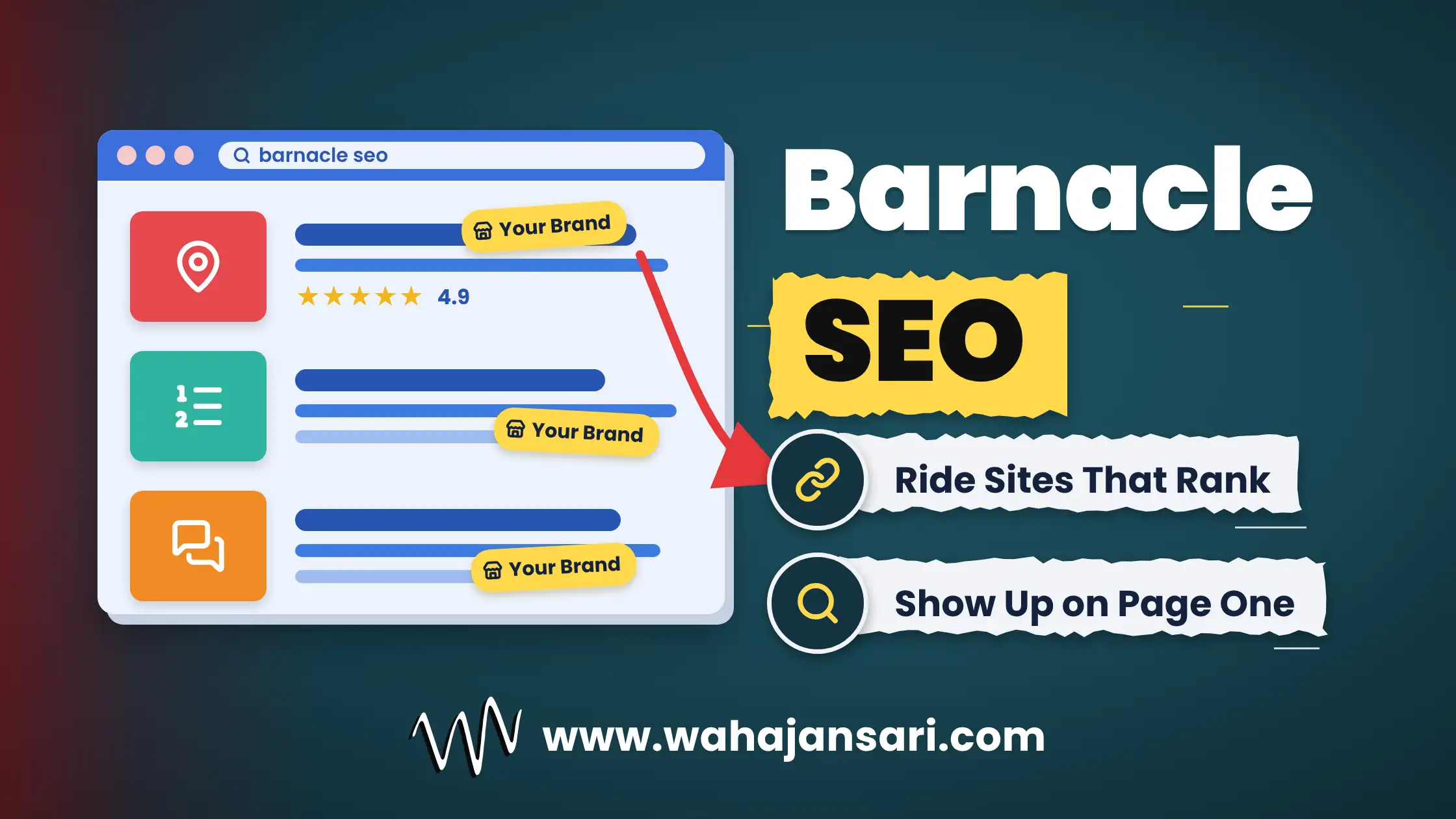
Here’s a search you’re probably not going to win: “best dentist in Chicago.” Page one belongs to the Google map pack, Yelp, a listicle from a big publisher, and a Reddit thread or two. Your shiny new website? It’s sitting somewhere on page four, and honestly, it might stay there for years.
So what is barnacle SEO? Barnacle SEO is a strategy where a small business borrows visibility from large, high-authority websites that already rank, such as Google Business Profile, Yelp, industry directories, listicles, and forums, instead of trying to outrank them with its own site. You don’t beat the big sites. You show up inside them.
I like this approach because it’s practical, it’s fast, and it works for keywords your site has no chance of ranking for yet. Below, I’ll walk you through how it works, real examples, the benefits and the catch, where Google draws the line, and exactly how to do it step by step.
How Does Barnacle SEO Work?
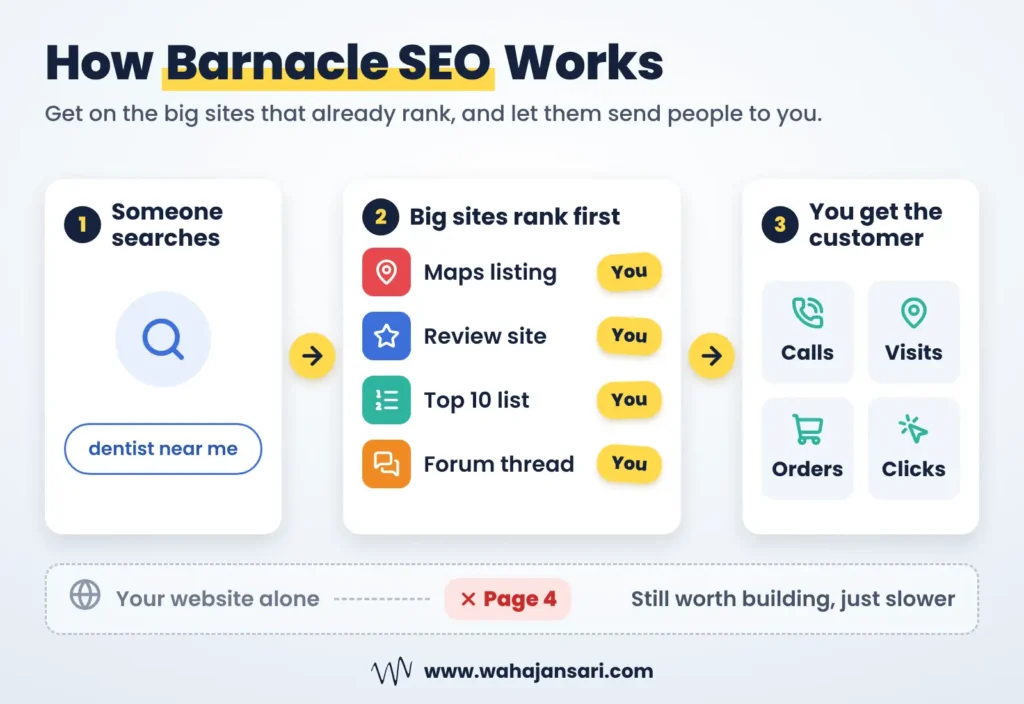
Barnacle SEO works by placing your business on pages Google already trusts and ranks, so their authority does the heavy lifting your own site can’t do yet. The name comes from the ocean: barnacles attach themselves to whales and get carried across thousands of miles without doing any of the swimming. Local SEO veteran Will Scott coined the term back in 2008, and the core idea hasn’t changed since.
That’s the website barnacle concept in one line: a small site attaching itself to a large site that already gets the traffic. The large site is your whale. Your profile, listing, mention, or forum answer on it is the barnacle, and every person who finds it gets pointed back to you.
Here’s the easiest way I can explain it. Imagine a home baker who opens a shop on a quiet back street and waits months for people to even notice it exists. Now imagine she sets up a stall at the busiest weekend food market in town instead. Same cakes, same recipes, a completely different crowd on day one.
Barnacling doesn’t replace your website, though. The goal is still to send people back to you, whether that’s a phone call, a booking, a visit, or a click to your site. The big site just gets you in front of them much sooner.
Barnacle SEO Examples You’ve Probably Seen Already
Once you know what to look for, you’ll spot this everywhere. Most businesses are already doing a half-hearted version of it without calling it anything. Here are a few barnacle SEO examples across different types of businesses:
| Business type | Host site (the whale) | What the barnacle looks like |
|---|---|---|
| Local plumber or dentist | Google Business Profile, Yelp, Angi | A complete profile with photos, services, and steady reviews |
| Restaurant or café | Tripadvisor, Google Maps, food delivery apps | A listing that shows up for “best brunch near me” style searches |
| SaaS company | G2, Capterra, “best tools” listicles | A product profile with real reviews and a spot in roundup articles |
| eCommerce brand | Amazon, Etsy, gift guides on big publications | Product listings plus inclusion in “best gifts for…” lists |
| Freelancer or consultant | Upwork, Fiverr, LinkedIn, Medium | A profile or article that ranks for “your skill + freelancer” searches |
| Any expert | Reddit, Quora, YouTube | Helpful answers and videos that rank for long, specific questions |
Notice the pattern? None of these businesses outranked the host site. They just made sure that when the host site ranked, they were on it, looking like the obvious choice once someone landed there.
Let me give you a quick scenario. A small project management tool will probably never outrank the big software review sites for “best project management software,” but it can show up on those exact pages with a well-built profile and real customer reviews. That’s a keyword it could chase for years on its own site, or appear for this quarter on someone else’s.
Let me walk you through one more scenario, this time for an eCommerce store. Say a family business in Savannah, Georgia, sells pecan gift boxes online, and they come to me in September asking why their site is invisible for “Georgia pecan gifts.” I pull up page one and the answer is obvious: Amazon, Etsy, a couple of big holiday gift guides, and a Reddit thread. Their collection page is stuck on page three, and it’s not climbing out before Christmas.
So I stop trying to outrank the giants and start getting the store onto them. First comes an Etsy shop with their five best sellers, real photos, and titles written the way people actually search, like “Georgia pecan gift box.” Then a fully built Google Business Profile for their small storefront, because “pecan gifts near me” pulls up the map pack for locals and tourists walking around Savannah.
Next, I pitch the editors behind the regional gift guides already ranking on page one. No “please add us” template, just a short note about a family-run pecan farm, real holiday shipping deadlines, and a product worth photographing. Any sample we send goes out with a clear note that a feature isn’t a condition, and any paid placement gets a sponsored link.
Then Reddit. Every November, people ask how long pecans stay fresh in the mail or what to send someone who has everything, so I answer those threads properly, with storage tips and no sales pitch.
By early December in this scenario, the store sits in two gift guides, its Etsy listing shows up for searches the website couldn’t touch, and the map pack sends in walk-in buyers. The collection page? Still on page three. And honestly, that season, it barely matters.
That’s barnacling in one story. The website keeps building authority in the background, while the big sites bring in the holiday orders right now.
Barnacle SEO Benefits (and the Catch Nobody Talks About)
The biggest benefit is speed: you get visibility for competitive searches now, not after a year of content and link building. But it comes with real trade-offs, and most people skip right past them. Here’s what you gain:
- Faster visibility. The host site already ranks, so a strong listing can start getting seen as soon as it’s live and indexed.
- Borrowed trust. A business with dozens of reviews on a platform people already use feels safer than an unknown website.
- Low cost. Most profiles and listings are free or cheap compared with the content and links it takes to rank your own page for the same term.
- More space on page one. Your site, your Google Business Profile, and a directory listing can all appear for the same search. That’s three shots instead of one.
- Keywords you couldn’t win otherwise. “Best service in city” searches are often packed with directories and listicles, and showing up on them is the only realistic way in for most small sites.
Now the catch. You don’t own any of these platforms, so you’re playing by their rules, and those rules change without asking you. A directory can redesign its pages, push paid listings above yours, or lose its own rankings overnight.
There’s also an attribution problem. Someone might find you on Yelp, Google your name later, and call you, and your analytics will never connect the two. My advice: treat barnacle traffic as a strong bonus channel, not the foundation your whole business sits on.
Barnacle SEO vs Traditional SEO
Comparing barnacle SEO vs traditional SEO really comes down to one question: whose page ranks? Traditional SEO works to get your own website to the top. Barnacling gets you onto pages that are already there.
| Factor | Barnacling | Traditional SEO |
|---|---|---|
| Whose page ranks | Someone else’s (directory, listicle, forum, marketplace) | Yours |
| Speed | Often fast, because the host already ranks | Slower, usually months of content and links |
| Control | Low, because the host sets the rules | High, because you own the site |
| Cost | Mostly time, sometimes paid placements | Content, technical fixes, and link building |
| What you build | Rented visibility | Owned visibility that compounds |
| Best for | Competitive and local keywords you can’t win yet | Lasting authority and traffic |
So which one should you pick? Both, honestly. Barnacling gets you seen this month, and traditional SEO builds the asset you’ll still own in three years. Think of it as renting a stall at the market while you build your own shop, not as an excuse to skip building the shop.
Barnacle SEO vs Parasite SEO: Where Google Draws the Line
Barnacling is not the same as parasite SEO, and mixing them up can get pages penalized. Barnacling means using big sites the way they’re meant to be used: a real profile, a real review, a genuine mention, a helpful answer. Parasite SEO means publishing your own low-value content on someone else’s domain purely to borrow its ranking power.
Google has a name for that second one: site reputation abuse. Google’s spam policies, last updated in August 2026, describe it as third-party content placed on a host site mainly to take advantage of the ranking signals that site has already earned. Outside the European Economic Area, those pages can receive a manual action, while inside the EEA Google may treat that section separately from the rest of the domain.
The same page lists guest posts and press releases with optimized anchor text in links as link spam. Paid or sponsored links are fine only when they carry a sponsored or nofollow attribute. So if your plan is to pay for a guest post with your keyword as the anchor text, that’s not barnacling. It’s a risk with a nicer name.
Here’s the simple test I’d use. If the host site would happily publish your listing, review, or answer even if Google didn’t exist, you’re a barnacle. If the only reason your content is on that domain is to rank, you’re a parasite.
How to Use Barnacle SEO, Step by Step
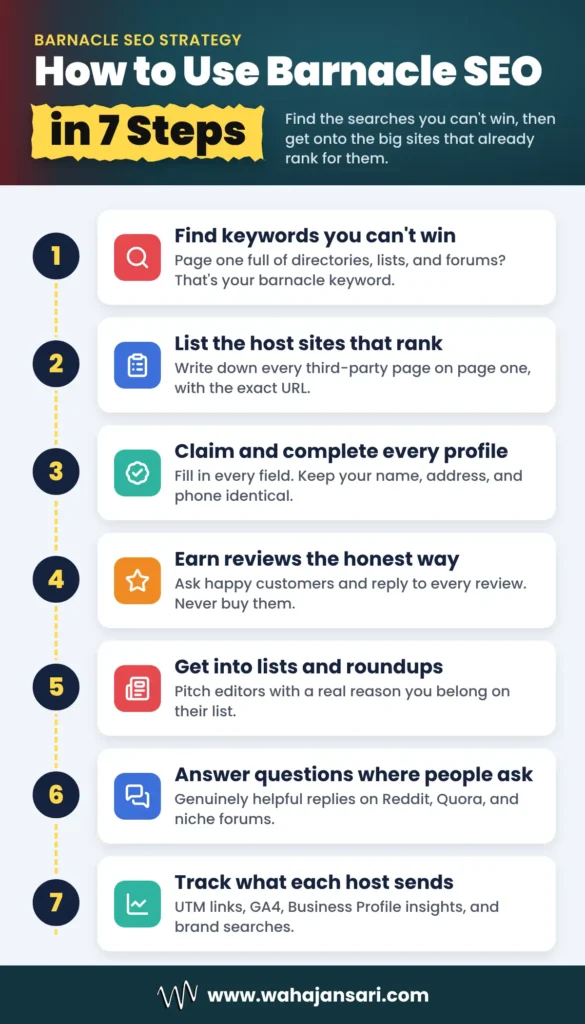
Here’s how to use barnacle SEO without wasting weeks on platforms that send you nothing. The process is simple: find the searches you can’t win, find out who’s winning them, and get yourself onto those pages properly.
1. Find the Keywords You Can’t Win on Your Own
Start with the searches that actually bring you customers and look at page one with your own eyes. If most of the results are directories, listicles, forums, marketplaces, or the map pack, you’ve found a barnacle keyword. Your site would need years of authority to break in, but those pages are already sitting there. Any keyword tool will show you a difficulty score, but a manual search tells you far more about who you’re up against.
2. List the Host Sites That Already Rank
For each barnacle keyword, write down every third-party page on page one, along with the exact URL that ranks. This list is your whole plan. A directory that ranks for “emergency plumber Dallas” is worth more than ten that rank for nothing.
Before you commit, check whether the host page gets real traffic and whether it lets people contact you or click through to your site. A listing on a site nobody visits is just a nice business card sitting in a drawer.
3. Claim and Complete Every Profile
Start with Google Business Profile, because it’s the most valuable listing for local searches, then move through the directories from step 2. Fill in everything: categories, services, hours, photos, and a description written for humans, not robots. Keep your business name, address, and phone number identical everywhere, so nobody (including Google) has to guess which version is right.
Half-finished profiles are where most barnacling efforts quietly die. If your listing looks abandoned next to a competitor’s with 40 photos and fresh replies to every review, guess who gets the call.
4. Earn Reviews the Honest Way
Reviews are what make a listing win once someone lands on the page, and they matter for rankings too. Google’s own guide to local ranking says prominence is based partly on how many websites link to your business and how many reviews you have. It also says more reviews and positive ratings can help your local ranking.
So ask every happy customer, make it easy with a direct review link, and reply to every review, good or bad. Don’t buy reviews or offer rewards only for positive ones. In the US, the FTC rule announced in August 2024 bans fake reviews and incentives tied to a particular sentiment, and platforms remove them anyway.
5. Get Into the Lists and Roundups That Rank
Search for “best” lists in your niche and city, and you’ll usually find a few listicles ranking near the top. Reach out to the writer or editor with a short, specific reason you belong there, like a unique feature, a local award, or strong reviews they can check. Don’t send a template that just says “please add us.” Editors get dozens of those every week.
You can also pitch journalists who are looking for expert sources. A single quote in a well-ranking article can keep sending you visitors for years, which is barnacling at its best.
6. Answer Questions Where People Already Ask Them
Reddit, Quora, and niche forums rank for a ridiculous number of long, specific questions. Find the threads ranking for your topics and add a genuinely helpful answer, the kind that would still be useful without your name attached. Read each community’s rules first, because many of them ban self-promotion and will delete a drive-by link fast. Honestly, if your answer only exists to drop a link, skip it.
7. Track What Your Barnacles Send You
Add UTM parameters to every link you control on host sites, so those visits show up clearly in Google Analytics 4 instead of blending into referral traffic. Check your Google Business Profile performance for calls, direction requests, and website clicks. And watch Google Search Console for growth in searches for your brand name, because people who find you on a host site often Google you next. Once a quarter, drop the platforms that send nothing and double down on the ones that do.
Why a Barnacle SEO Strategy Matters More in AI Search
Barnacling matters even more now that a lot of searches end in an AI answer. Google says AI Overviews and AI Mode may run several related searches across subtopics (it calls this query fan-out) and can show a wider and more varied set of supporting links than a classic results page. Its AI features documentation also says there are no extra requirements: pages just need to be indexed and eligible to appear with a snippet.
Here’s why that matters to you. When an answer is built from many sources, the business that appears on the directory, the listicle, and the forum thread has more chances to be included than the business that only lives on its own site.
So my view of a barnacle SEO strategy is simple: get mentioned, accurately and consistently, everywhere your customers already look. I can’t promise any AI tool will cite you, and anyone who does is guessing. But being mentioned in more trusted places is the most practical bet you can make.
Barnacling Mistakes That Waste Your Time
Most barnacling fails for boring reasons, not because the strategy doesn’t work. Here are the mistakes I’d avoid:
- Spreading too thin. Twenty half-built profiles lose to five complete ones that actually rank.
- Picking hosts that don’t rank. If a directory isn’t on page one for your keywords, it’s not a whale. It’s a puddle.
- Treating forums like billboards. Drive-by links get removed, and they make your brand look desperate.
- Faking social proof. Bought reviews and unmarked paid links can backfire with platforms, Google, and regulators.
- Ignoring your own website. Every barnacle should lead somewhere good, and a slow, confusing site wastes all the visibility you worked for.
FAQs
Does barnacle SEO still work?
Yes, barnacle SEO still works, as long as you use host sites the way they’re meant to be used. Directories, review platforms, listicles, and forums still take up a lot of space on page one for competitive and local searches. What no longer works is publishing thin content on big domains just to borrow their rankings, which Google treats as site reputation abuse.
Is barnacling only for local businesses?
No, local businesses use it most, but it works for almost any business. SaaS companies barnacle on software review sites, eCommerce brands on marketplaces and gift guides, and freelancers on platforms like Upwork and LinkedIn. If big third-party pages rank for your keywords, there’s an opportunity.
Is barnacling white hat?
Yes, it’s white hat when you follow each platform’s rules and Google’s spam policies. Claiming listings, earning real reviews, getting featured on merit, and answering questions honestly are all legitimate. It turns grey or black hat when you buy links, fake reviews, or publish spammy content on someone else’s domain.
How long does barnacling take to show results?
It’s usually faster than ranking your own pages, because the host site already ranks. A complete Google Business Profile or directory listing can start getting views once it’s live and indexed, while a spot on a listicle depends on how quickly the editor updates it. Reviews and forum reputation build more slowly, so give it a few months before judging the whole strategy.
Final Thoughts
If your site is new or your industry is crowded, barnacle SEO is the fastest honest way onto page one. Pick the host sites that already rank for your money keywords, build profiles that look better than your competitors’ profiles, and earn your place on lists and threads instead of buying it.
Just don’t forget that you’re renting someone else’s stall. The barnacles bring people in today, but your own website is what you’ll still own when the platforms change their rules. Start with one keyword this week and see who’s ranking for it.
Discover more from Wahaj Ansari
Subscribe to get the latest posts sent to your email.