
Open ChatGPT right now and ask it: “What are the best [your service] companies in [your city]?”
Did your brand show up?
If it didn’t, you’re not alone. Plenty of businesses rank decently on Google and still don’t exist in AI answers. And the reason usually isn’t bad content. It’s that search engines and AI tools aren’t sure who you are, what you do, or whether anyone outside your own website vouches for you.
That’s exactly what brand entity optimization fixes. In this post, I’ll show you how to make your brand clear to machines, how to get it talked about in the places that matter (including what I’d do at each budget level), and how to check whether any of it is working.
Type your brand details once. Get your one-liner, Organization schema, a profile name check, and a monthly AI visibility tracker.
Decide how your brand introduces itself: one sentence, same wording everywhere.
Keep it in one place. Save this sentence in a shared doc your team and writers copy from, and reuse it in every bio, listing, and guest post. Refine it once, then leave it alone.
What Brand Entity Optimization Actually Means
Think of your brand like a new person who just moved into a neighborhood.
On day one, nobody knows them. If the person introduces themselves as “Ali, the dentist” at one house, “Ali, the dental clinic owner” at another, and “Dr. A” at a third, the neighbors get confused. Is that one guy or three?
Now imagine the local shopkeeper, the mosque imam, and the school principal all say, “Oh, Ali? Great dentist, he fixed my kid’s tooth.” Suddenly the whole street knows him. And trusts him.
Google and AI tools work the same way.
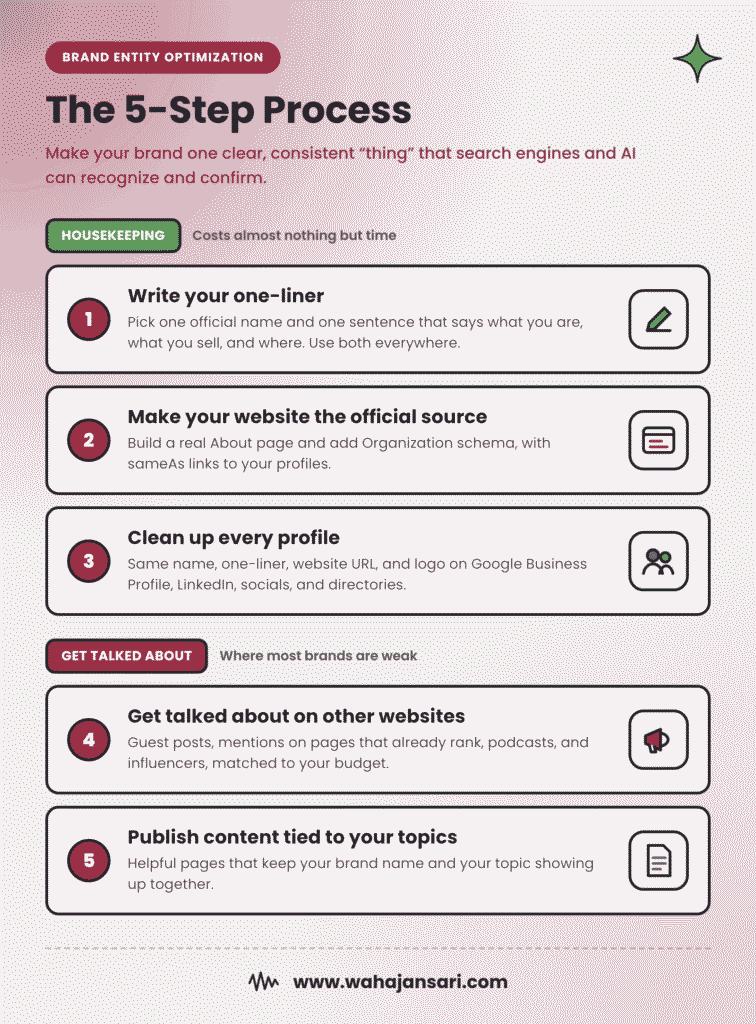
Brand entity optimization is the work of making your brand one clear, consistent “thing” that search engines and AI assistants can recognize, connect to the right topics, and confirm through other trusted sources. You describe yourself the same way everywhere, you label your identity with structured data, and you get credible websites, podcasts, and creators talking about you.
The first part is housekeeping. The second part (getting talked about) is where most brands are weak, and it’s where I’ll spend the most time.
Why This Matters More Than It Did a Few Years Ago
Here’s the thing about AI answers: they shrink the shortlist.
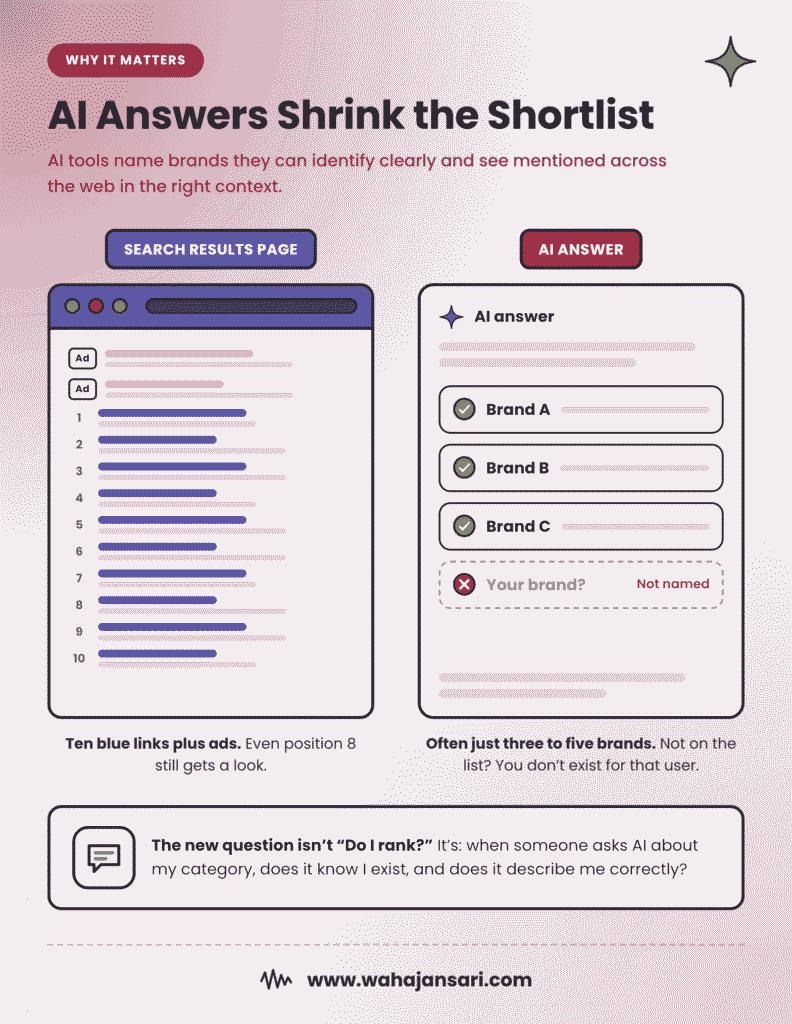
A Google results page gives you ten blue links and a bunch of ads. An AI answer often names three to five brands and that’s it. If you’re not in that small group, you don’t get a “position 8” consolation prize. You just don’t exist for that user.
And AI tools don’t pick those names randomly. They lean on brands they can identify clearly and see mentioned across the web in the right context. A brand with a messy identity and zero third-party mentions is basically invisible, even if its website is lovely.
So the real question isn’t “Do I rank?” anymore. It’s “When someone asks an AI about my category, does it know I exist, and does it describe me correctly?”
A while back, a client who runs a small bakery called me late one night. He sounded genuinely upset.
“Wahaj, ChatGPT thinks I’m a dairy company.”
I laughed. Then I checked. He was right.
I asked ChatGPT about his brand (let’s call it Golden Meadow), and it told me, with full confidence, that Golden Meadow sold “fresh milk, butter, and cheese.” Not a single word about cakes. He does use a lot of butter. He just doesn’t sell it. That same week, a customer had walked in asking for a crate of milk.
Here’s what happened. A few towns over, there was a dairy brand with almost the same name: Golden Meadow Dairy. That brand used one name and one description, and it was listed everywhere. My client was “Golden Meadow” on Instagram, “Golden Meadow Bakes” on Google, and “GM Bakery” on Facebook, with a different description on each.
So the AI did what any confused stranger would do. It saw two similar names, one with a clear story and one with a messy story, and assumed they were the same business. The clear story won.
To be fair, it wasn’t a crazy mistake. Bakery, dairy, butter, cream: they sit on the same shelf. That’s exactly why it happened.
We cleaned it all up, and a few months later ChatGPT finally understood that he bakes cakes and doesn’t milk cows. But what stuck with me was this: once I started looking, I saw many businesses making the same mistake. They had good websites and decent rankings, and a complete mess everywhere else.
So I did some research. I went through Google’s own documentation, studied what other SEOs were doing, and tested a lot of prompts across ChatGPT, Gemini, and Perplexity. Then I combined everything into an easy-to-follow brand entity optimization process that any business can actually use.
That process is what this post is about. I’ll show you how to make your brand clear to machines, how to get it talked about in the places that matter (including what I’d do at each budget level), and how to check whether any of it is working.
Step 1: Write Your Brand’s One-Liner (and Use It Everywhere)
Before you touch schema or outreach, decide how your brand introduces itself. One sentence. Same wording, everywhere.
Something like:
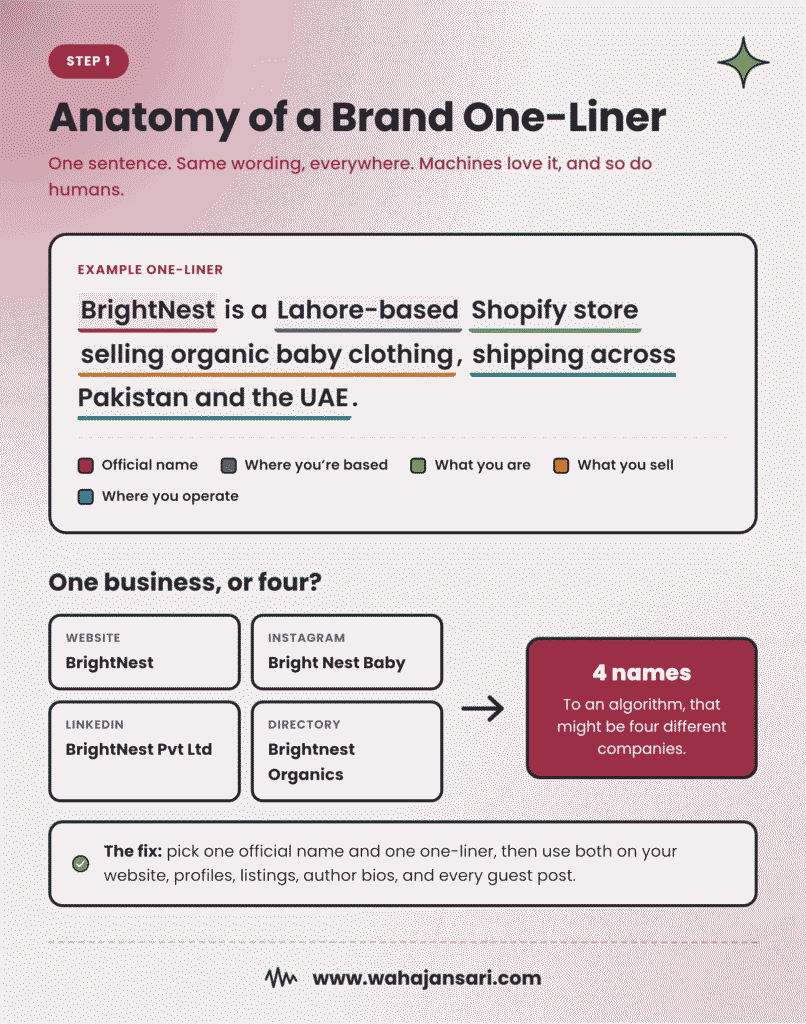
“BrightNest is a Lahore-based Shopify store selling organic baby clothing, shipping across Pakistan and the UAE.”
That sentence answers what you are, what you sell, who it’s for, and where you operate. Machines love that. So do humans, honestly.
Now here’s the mistake I see a lot: the brand calls itself “BrightNest” on the website, “Bright Nest Baby” on Instagram, “BrightNest Pvt Ltd” on LinkedIn, and “Brightnest Organics” on a directory. To you, it’s obviously the same business. To an algorithm, that’s four slightly different names that might be four different companies.
Pick one official name. Pick one one-liner. Then use both on your website, social profiles, directory listings, author bios, and (this is important for later) every guest post and mention you get.
Keep that one-liner in a simple doc that your whole team and any writer you hire can copy from. It sounds boring. It’s also the foundation everything else sits on.
Step 2: Make Your Website the Official Source
Your website should be the place that settles any argument about who you are.
Build a real About page
Not a “We are passionate about excellence” page. A useful one. Include your official name, your one-liner, what you offer, who you serve, where you’re based, when you started, who runs the business, and links to your official profiles.
If an AI tool landed only on your About page, could it describe your business correctly in two sentences? If not, rewrite it.
Add Organization schema to your homepage
Google’s documentation on organization structured data says adding it to your home page can help Google understand your organization’s administrative details and disambiguate your organization in search results. No property is strictly required, so add the ones that genuinely apply to you.
The most useful one for entity work is sameAs. It’s basically you telling Google, “These profiles on other sites are also me.” Here’s a simple example:
<script type="application/ld+json">
{
"@context": "https://schema.org",
"@type": "Organization",
"name": "BrightNest",
"url": "https://www.brightnest.example",
"logo": "https://www.brightnest.example/logo.png",
"description": "BrightNest is a Lahore-based Shopify store selling organic baby clothing, shipping across Pakistan and the UAE.",
"foundingDate": "2021",
"sameAs": [
"https://www.linkedin.com/company/brightnest-example",
"https://www.instagram.com/brightnest.example",
"https://www.facebook.com/brightnest.example"
]
}
</script>
Notice the description is the same one-liner from Step 1. That’s not an accident.
If you run a store, also link your products back to your brand through the brand property in your Product schema. Every product page then quietly reinforces who makes it.
One honest warning: schema is a label, not a magic switch. If your schema says one thing and the rest of the internet says another, the schema won’t win that argument on its own.
Step 3: Clean Up Every Profile That Talks About You
Now go outside your website and tidy up the places that already describe you.
Start with the ones you control: Google Business Profile (if you serve customers locally), LinkedIn, Facebook, Instagram, YouTube, X, and any industry directories you’re listed on. Then check the bigger data sources in your space, like Crunchbase for startups, Clutch for agencies, or marketplace seller pages for eCommerce.
For each one, check four things: the exact brand name, the one-liner (or a close version of it), the website URL, and the logo.
Let me give you an example. A client sells skincare and has an old directory listing pointing to a dead domain from before a rebrand. That listing is basically telling the internet a second, outdated story about the brand. Fix it or remove it.
What about Wikipedia and Wikidata? If your brand is genuinely notable and covered by independent press, they’re powerful. But don’t force it. A self-promotional entry that gets deleted helps nobody, and editors on those sites are not known for their sense of humor about it.
Step 4: Get Your Brand Talked About on Other Websites
This is the part that actually moves the needle, and it’s where most guides wave their hands and say “earn third-party mentions.” Fine. But how?
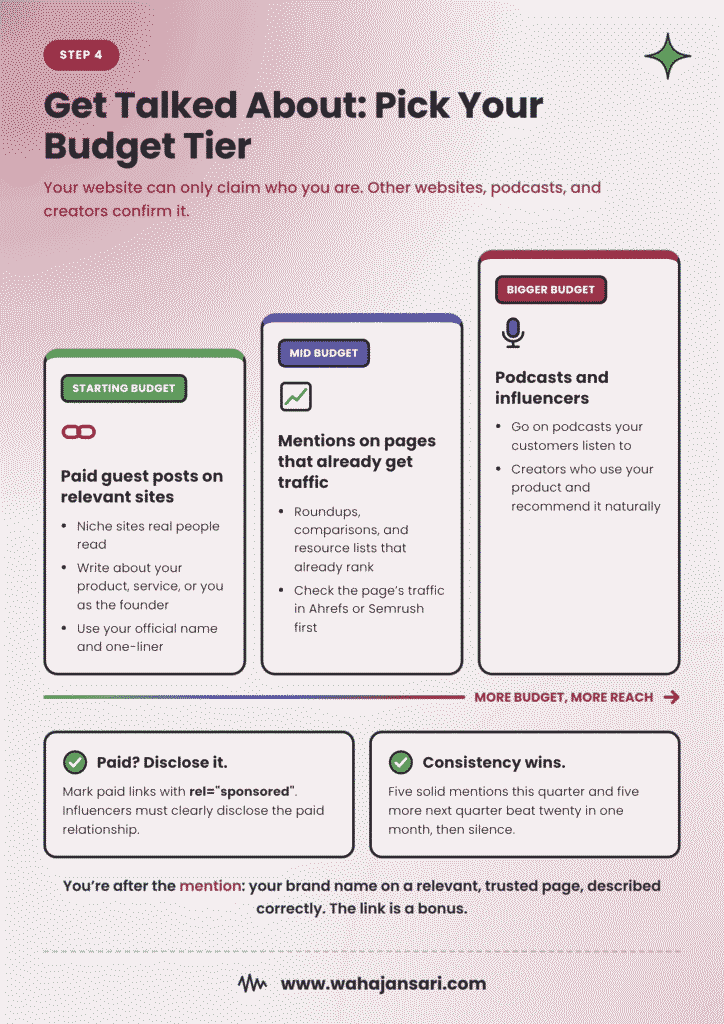
Here’s my approach. Your website can only claim who you are. Other people’s websites, podcasts, and videos confirm it. The more relevant places that mention your brand name alongside your topic, the more confident Google and AI tools become that you’re a real, credible player in that space.
I split this by budget, because a local bakery and a funded SaaS company shouldn’t be running the same playbook.
Starting budget: paid guest posts on relevant sites
Find websites in your niche that real people actually read, and pay for guest posts where you write about your product, your service, or yourself as the founder or expert behind the brand.
The key words there are relevant and real. A guest post about your baby clothing brand on a parenting blog with genuine traffic is worth far more than ten posts on random “write for us” sites that publish everything from crypto to car parts.
Inside each post, use your official brand name and your one-liner naturally. That’s how the same story about you starts repeating across the web.
Now, a quick but important rule. If you paid for the placement, any link back to you should be marked as paid. Google’s guidance on qualifying outbound links asks sites to tag advertisements and paid placements with rel="sponsored".
Does that make paid guest posts useless? Not at all. For entity work, you’re mainly after the mention: your brand name, sitting on a relevant, trusted page, described correctly. The link is a bonus, not the point. So don’t stress about getting a followed link. Stress about getting a good page.
Mid budget: brand mentions on pages that already get traffic
Instead of creating brand new pages, get your brand mentioned on existing pages that already rank and already get visitors. Think “best organic baby brands in Pakistan” roundups, tool comparison posts, or resource lists in your niche.
Why existing pages? Because they’re already trusted, already crawled, and already being read by humans (and pulled into AI answers). A new guest post has to earn its place. An existing page with steady traffic already has it.
Check the page’s traffic in Ahrefs or Semrush before paying anything. If a page gets zero organic visitors, it’s not a vote of confidence for anyone, including you.
The same rule applies here: if the mention or link was paid for, it should be disclosed as sponsored.
Bigger budget: podcasts and influencers
If your budget is genuinely healthy, this is where I’d put serious money.
Go on podcasts as the face of your brand. When you appear as the founder or expert representing your company, your brand name gets said out loud, written in the show notes, repeated in the transcript, and often clipped on YouTube. That’s several fresh mentions from one conversation, all tying your brand to your topic. And since you’re talking for 30 to 60 minutes, you get to explain what you do in your own words, which is exactly the kind of context AI tools pick up on.
Pick shows your customers actually listen to. A small, focused industry podcast often beats a big general one.
Hire influencers to mention and recommend your brand naturally. Not a stiff ten-second ad read that everyone skips. A creator actually using your product, saying your brand name clearly, and explaining why they’d recommend it. That kind of mention spreads into comments, reposts, and searches for your brand name.
One non-negotiable: the creator has to disclose the paid relationship. In the US, the FTC’s Disclosures 101 for Social Media Influencers says an endorsement should make it obvious when the creator has a material connection with the brand. Other countries have their own rules, so check yours. “Natural” means natural delivery, not hidden sponsorship.
So which tier should you start with? Honestly, whichever one you can do consistently. Five solid mentions this quarter and five more next quarter beat twenty random ones in a single month and then silence.
Step 5: Publish Content That Ties Your Brand to Your Topics
Mentions tell machines you exist. Your own content tells them what you’re about.
If you want your brand connected to “organic baby clothing,” then your site should have genuinely helpful pages on that topic: fabric guides, sizing help, care instructions, comparisons. Over time, your brand name and that topic keep showing up together, on your site and off it.
Two quick tips. Start each important page with a direct, two or three sentence answer before you expand, because that’s the part AI tools find easiest to lift. And add a short FAQ where real questions exist, not where you’re inventing them to fill space.
How to Check If Brand Entity Optimization Is Working
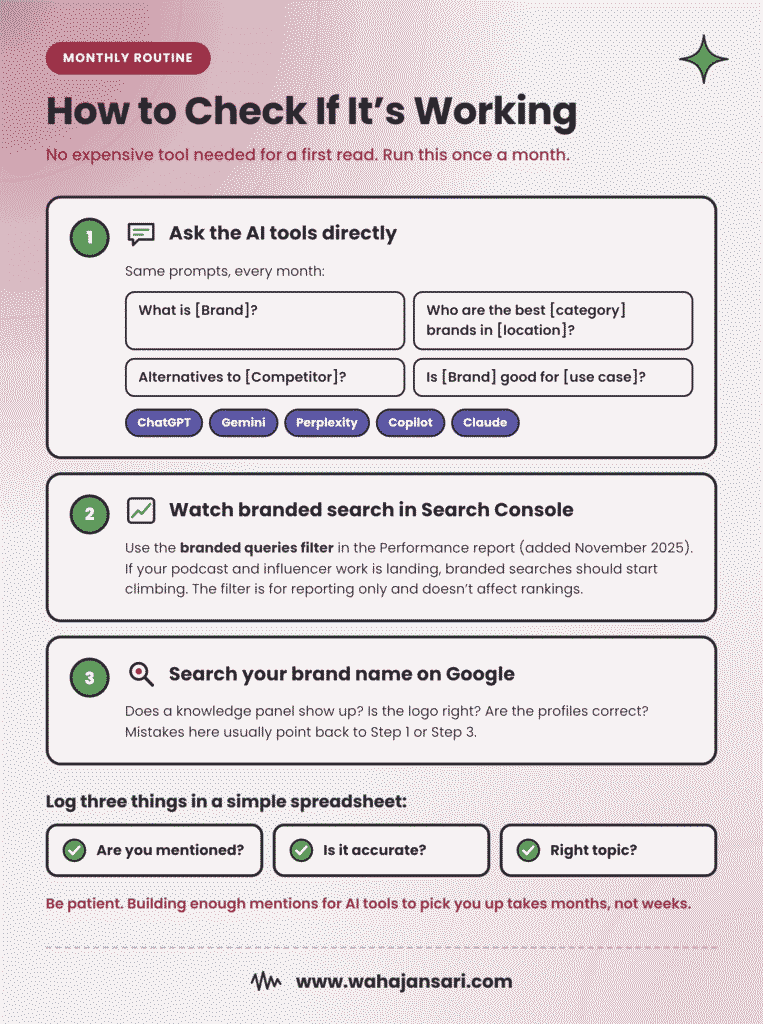
You don’t need an expensive tool to get a first read. Here’s a simple routine I’d run once a month.
1. Ask the AI tools directly. Use the same set of prompts every time in ChatGPT, Gemini, Perplexity, Copilot, and Claude:
- “What is [Brand]?” (Does it describe you correctly?)
- “Who are the best [category] brands in [location]?” (Are you on the shortlist?)
- “Alternatives to [Competitor]?” (Do you show up as an option?)
- “Is [Brand] good for [use case]?” (Does it connect you to the right use case?)
Write the answers in a simple spreadsheet. You’re looking for three things over time: are you mentioned, is the description accurate, and are you tied to the right topic.
2. Watch branded search in Search Console. Google added a branded queries filter to the Search Console Performance report in November 2025. It separates searches that include your brand name or closely associated products from everything else. If your podcast and influencer work is landing, branded searches should start climbing. (Google notes the filter is just for reporting and has no effect on rankings.)
3. Search your brand name on Google. Does a knowledge panel show up? Is the logo right? Are the profiles correct? Any mistakes here usually point back to an inconsistency from Step 1 or Step 3.
Be patient. This isn’t a “change it Monday, see it Tuesday” kind of SEO.
Mistakes I’d Avoid
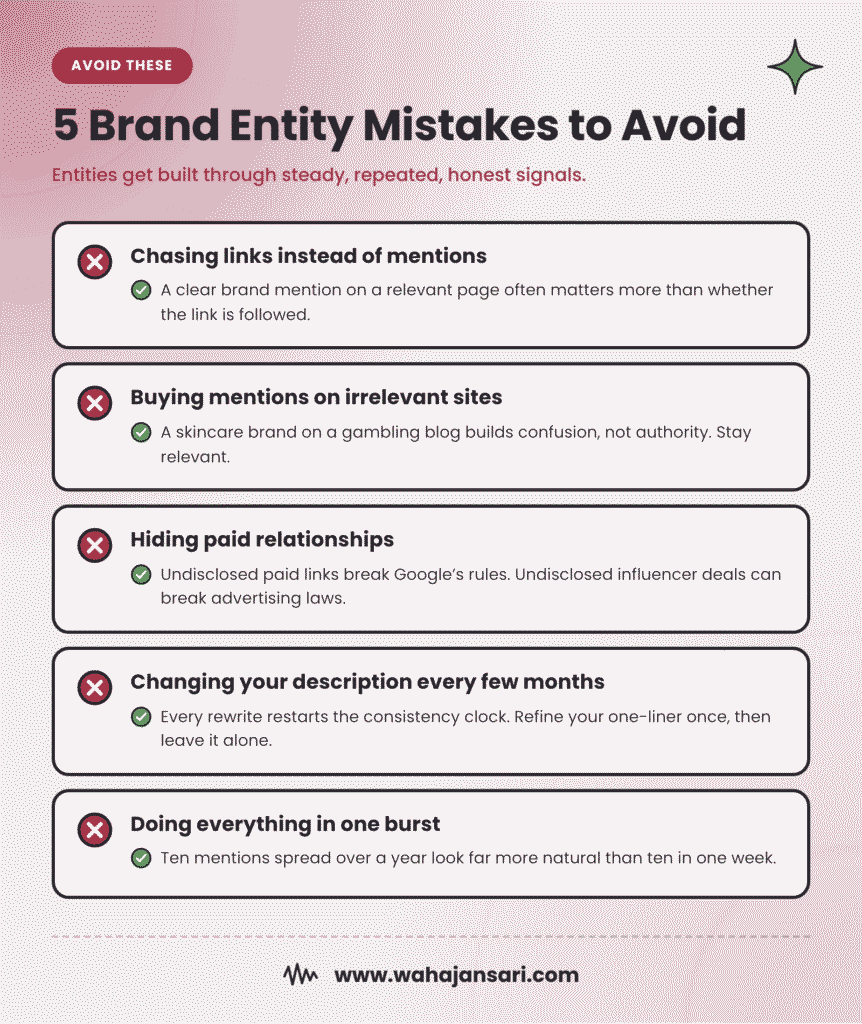
Chasing links instead of mentions. For entity work, a clear brand mention on a relevant page often matters more than whether the link is followed.
Buying mentions on irrelevant sites. A mention of your skincare brand on a random gambling blog doesn’t build authority. It builds confusion (and possibly a reputation problem).
Hiding paid relationships. Undisclosed paid links break Google’s rules, and undisclosed influencer deals can break advertising laws. Neither is worth the risk.
Changing your description every few months. Every rewrite of your one-liner restarts the consistency clock. Refine it once, then leave it alone.
Doing everything in one burst. Entities get built through steady, repeated signals. Ten mentions spread over a year look far more natural than ten in one week.
Quick Answers to Common Questions
Is brand entity optimization the same as entity SEO?
They overlap a lot. Entity SEO is the broader idea of optimizing around things (people, places, products, concepts) instead of just keywords. Brand entity optimization is the slice of that focused on your company: making sure your brand is recognized, described correctly, and linked to the right topics.
How long does it take to see results?
It depends on how messy your current signals are and how much off-site activity you can sustain. Cleaning up your name, profiles, and schema is quick. Building enough consistent mentions for AI tools to pick you up takes months, not weeks.
Can a small business do this without a big budget?
Yes. Steps 1 to 3 cost almost nothing but time. After that, a handful of well-chosen guest posts on relevant sites is a realistic starting point. Podcasts and influencers can come later when the budget allows.
Final Thoughts
If you remember one thing from this post, make it this: you can’t just tell Google and AI tools who you are. Other people have to back you up.
Get your house in order first. One name, one one-liner, clean profiles, proper schema. Then spend your energy and budget on getting talked about in the right places, whether that’s a few paid guest posts, mentions on pages that already get traffic, or a podcast tour and a couple of honest influencer partnerships.
Do it consistently, keep it transparent, and check your progress every month by simply asking the AI tools about yourself.
Because the next time someone asks ChatGPT for the best option in your category, you want to be in that answer. And you want it to describe you correctly.
Discover more from Wahaj Ansari
Subscribe to get the latest posts sent to your email.