
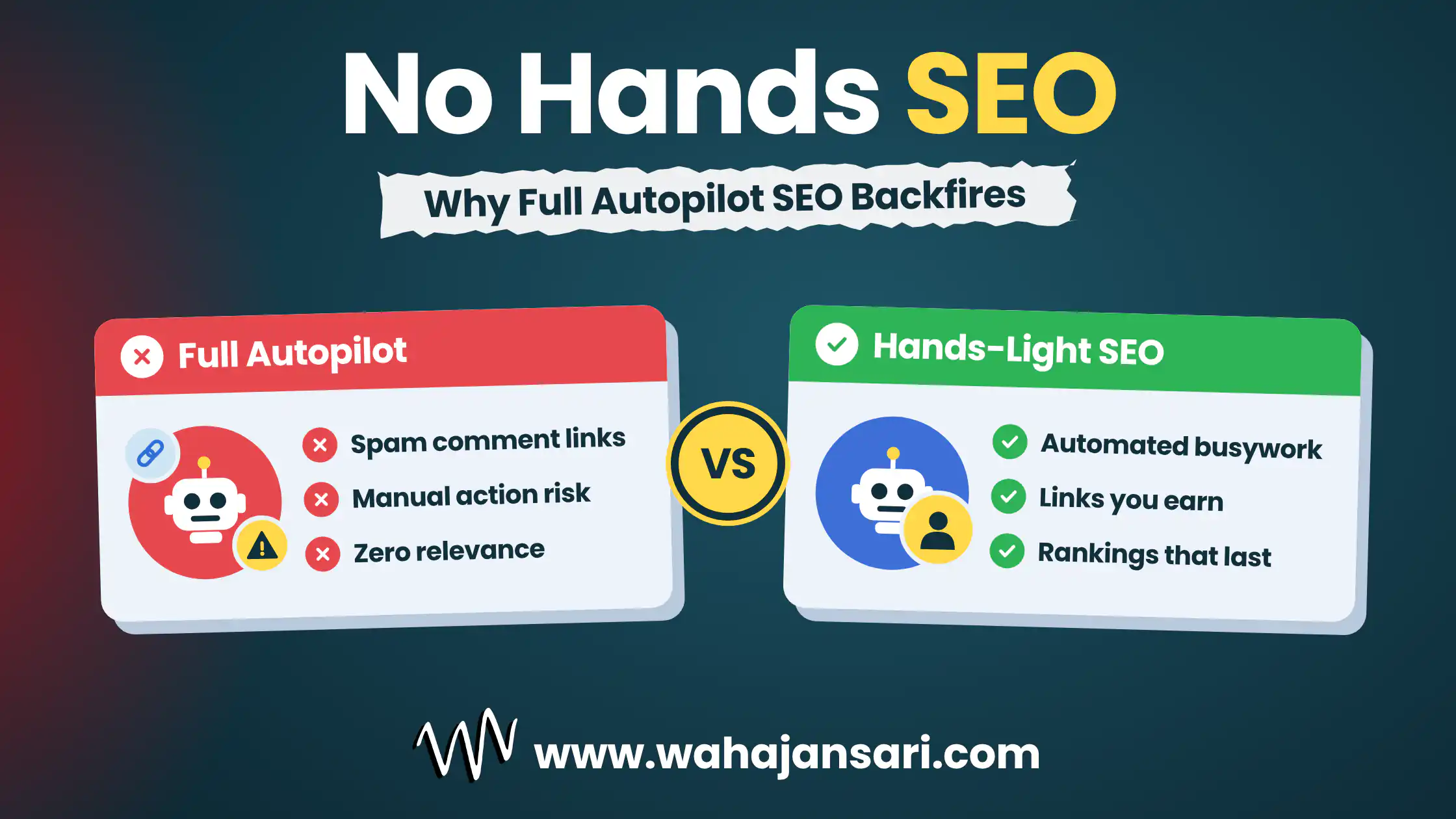
You’ve probably seen the pitch. Install a tool, type in your URL, go make chai, and come back to page one rankings. That dream has a name, and it’s a lot older than the AI tools everyone’s excited about right now.
No Hands SEO is a Windows desktop tool, launched around 2011, that builds backlinks on autopilot. You enter a URL, keywords, and anchor text, and the software finds blogs, posts comments and trackbacks, submits your site to whois and stats pages, then pings every new link. The name now also gets used for any fully automated, set and forget approach to SEO.
If you typed “what is no hands SEO” after spotting the name in an old forum thread or a cheap backlink gig, you’re asking at exactly the right time. In 2026, the real question isn’t what the tool does. It’s whether any SEO should run with nobody’s hands on it, and that’s what this post answers, along with what I’d happily automate instead.
Is your SEO tool, plugin, or agency doing smart automation or risky autopilot? Tick everything it does for you automatically, then check your risk.
No Hands SEO Meaning: A Tool First, a Buzzword Now
There are two answers here, depending on who’s talking. Old school SEOs mean the actual software, a link building program people bought for a one-time fee and left running on a spare PC. Newer folks use the phrase loosely for any hands-off setup where software or AI does the SEO work while you sleep.
It’s the same thing that happened to Surf in Pakistan. It’s one detergent brand, but half the country calls every washing powder “Surf”. The tool’s name went the same way, and now “no hands” basically means SEO on autopilot.
Both meanings lead to the same question, though: can SEO run without a human making the decisions? I’ll be honest, I’m a big fan of automation. I’m just not a fan of autopilot, and those are two very different things.
How the Original Tool Works, Step by Step
The tool works like a robot that goes door to door, leaving your business card at every blog it can find. You set it up once, press start, and it keeps going until you stop it. Here’s the basic flow:
- Create a profile. You add your URL, target keywords, and the anchor texts you want.
- It crawls your site. It finds your inner pages so it can promote more than just the homepage.
- It scrapes for targets. It hunts for blogs, image pages, and other spots where comments or trackbacks are open, filtered by settings like PageRank and outbound link count.
- It posts. Spun comments and trackbacks go out with your link, routed through proxies so your IP doesn’t get blocked. It also submits your domain to whois and website stats pages that link back to you.
- It checks and pings. It confirms which links went live, then pings them so search engines find them faster.
At the time of writing, the official site still sells a single license for $77. So the software is very much alive, even if the strategy behind it isn’t.
Now notice what’s missing from that list. Nobody checks whether the blog has anything to do with your business.
Your plumbing site could end up with a comment on a 2010 Blogspot post about guitar lessons, right next to 400 other comments selling pills. That’s not a backlink. That’s graffiti.
Does No Hands SEO Still Work in 2026?
Short answer: not for any site you care about. The tool was built for a version of Google that leaned heavily on counting links, and that version of Google is long gone. Today, the links this kind of software creates are exactly what Google’s spam systems are trained to catch.
First, Google calls it out by name. Its spam policies list “using automated programs or services to create links to your site” as link spam, and they treat comment spam on blogs as a problem of its own. You don’t often see Google describe your exact tool in its rulebook, but here we are.
Second, the links carry very little weight even when they stick. Google recommends that site owners mark links in comments and forum posts with the ugc attribute, which flags them as user-generated rather than editorially chosen. So the tool is basically mass-producing the one kind of link Google has already asked everyone to label. Thousands of them, every day, all wearing the same name tag.
Third, Google got a lot better at catching this. Its ranking systems guide says Penguin, a system built to fight link spam, was announced in 2012 and folded into the core ranking systems in 2016, and Google keeps updating spam detection systems like SpamBrain as spam tactics change. The tool launched around 2011, roughly a year before Penguin showed up. Talk about bad timing.
So what actually happens if you run No Hands SEO today? Best case, Google quietly ignores the links and you’ve wasted $77 plus a lot of electricity. Worst case, you get an “Unnatural links to your site” manual action in Search Console, and you spend weeks cleaning up a mess a robot made in an afternoon.
A while back, the owner of a small streetwear brand in Atlanta, Georgia reached out to me. His Shopify store’s Google traffic had dropped by more than half in two months, right before his fall collection launch. The first thing he said on our call was, “I don’t get it, bro. I have 30,000 backlinks.”
That number made me nervous before I’d even logged in. A previous freelancer had sold him a “set it and forget it” link package, which turned out to be a No Hands SEO style tool running for four months straight. Thousands of blog comments and trackbacks, all pointing at his homepage and collection pages with anchors like “cheap streetwear Atlanta” and “graphic tees Georgia”.
Then I opened his Search Console, which he admitted he’d never logged into. Sitting right there was an “Unnatural links to your site” manual action, almost three weeks old and completely unread. His links report looked exactly like the graffiti I described earlier: a 2011 recipe blog, a Polish forum about car parts, and a guestbook page with more spam than guests.
Here’s what we did, and none of it was automated. I exported every linking domain, went through them by hand (well, with a spreadsheet and a lot of chai), and disavowed the spammy ones. Then we cancelled the link package and filed a reconsideration request that explained what happened, what we cleaned up, and what would stop it from happening again.
The manual action was lifted in about four weeks. But here’s the part most people don’t expect: his rankings didn’t bounce back the next morning. Lifting a penalty takes your foot off the brake. It doesn’t press the gas.
So we went hands-light. I automated the boring stuff, like weekly crawls, Search Console alerts, and a Looker Studio report he could actually read. Everything else got human hands on it.
We rewrote his collection pages around the fit, fabric, and styles people actually search for, added product schema, and fixed the internal links between collections. Then we pitched his fall lookbook to a few Atlanta fashion bloggers and a local lifestyle site. Slow work, but every link we earned came from somewhere his customers actually hang out.
Six months later, his main collection pages were back on page one for a handful of local terms, and organic sales had climbed past where they were before the drop. He now has around 40 real backlinks instead of 30,000 junk ones. And honestly? Those 40 have done more for his brand than the 30,000 ever did.
No Hands SEO vs Traditional SEO
The biggest difference is who makes the decisions. With the autopilot approach, a program decides where your links go and what your comments say. With traditional SEO, a human picks targets based on relevance, writes for actual readers, and earns links instead of dropping them. Here’s how the two stack up side by side:
| Autopilot (no hands) approach | Traditional SEO | |
|---|---|---|
| Who decides | Software | You or your SEO |
| Where links come from | Open comment sections, trackbacks, whois and stats pages | Relevant sites that choose to link to you |
| Relevance | Whatever the scraper finds | Picked on purpose |
| Speed | Thousands of links, fast | A few strong links at a time |
| Risk | Listed as link spam in Google’s policies | Low when done white hat |
| Long-term value | Usually ignored or devalued | Builds up over time |
Sure, the left column looks faster on paper. But speed doesn’t matter if Google ignores every link, and the right column is the only one that still compounds. I’d rather have ten links from sites my customers actually read than ten thousand from comment sections nobody has opened since 2014.
No Hands SEO Automation: What You Can Safely Put on Autopilot
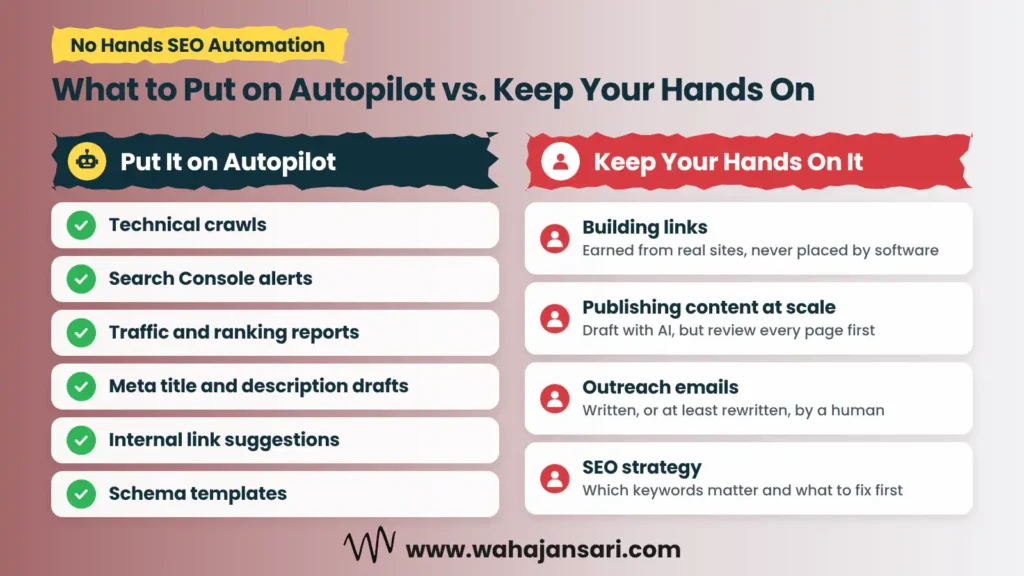
Here’s where I might surprise you: I’m all for automation. The trick is automating the grunt work that collects data or drafts things, and keeping your hands on anything that publishes, links, or speaks for your brand. Google’s own guidance on generative AI content doesn’t tell you to avoid AI, but it does ask you to fact-check and review AI content before it goes live.
That’s a pretty clear line, and it’s the one I’d follow. Here’s what I’d happily automate:
- Technical crawls. Schedule a regular crawl so broken links, redirect chains, and missing tags land in your inbox.
- Search Console alerts. Let Google email you about indexing issues and manual actions instead of checking every morning.
- Traffic and ranking reports. Connect your data to a dashboard once and stop rebuilding the same report every month.
- First drafts of meta titles and descriptions. AI is great at giving you ten options. You pick one and edit it.
- Internal link suggestions. Tools can spot pages that should link to each other, and you approve the ones that make sense.
- Schema templates. Product or FAQ markup built from a template, checked once, and reused everywhere.
Now the other side of the line. These are the jobs where one bad automated decision can cost you months, so a human stays in charge:
- Building links. Any tool that places links without a real person choosing to link to you is a link scheme waiting to happen.
- Publishing content at scale. Drafting with AI is fine, but auto-publishing hundreds of unreviewed pages is how sites end up with a scaled content abuse problem.
- Outreach emails. A “personalized” template blasted to 5,000 inboxes isn’t personal, and editors can smell it.
- Strategy. Which keywords matter, which pages to merge, and what your audience actually needs. That’s the job, not the chore.
A Smarter No Hands SEO Strategy: Hands Light, Not Hands Off
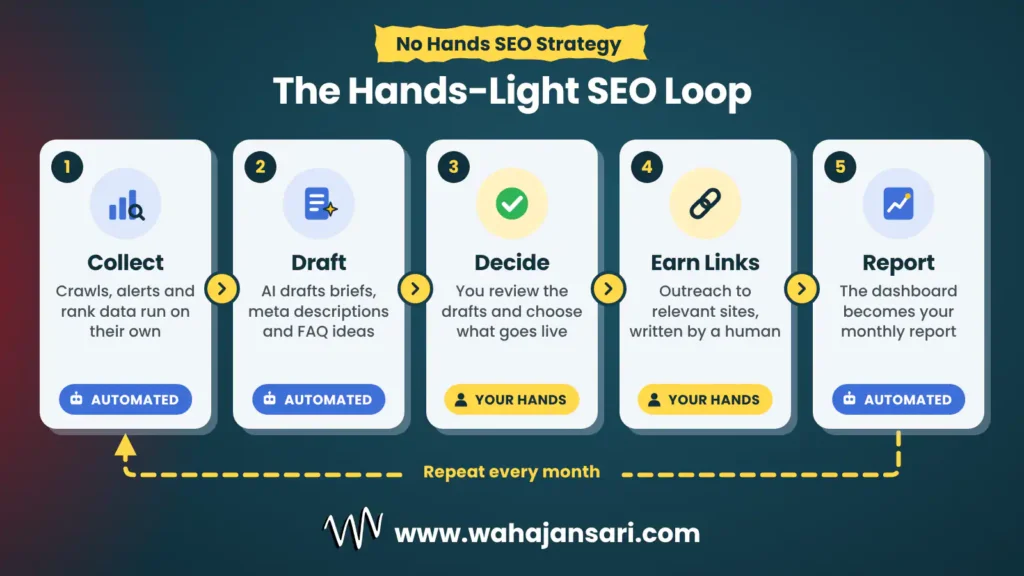
The best no hands SEO strategy isn’t hands-off at all. It’s hands-light: machines collect and draft, a human decides and approves, and nothing goes live without someone checking it.
Think of it like a washing machine. It does all the scrubbing, which is the boring part, but you still sort the whites from the colors before you press start. Skip that step and let the machine decide, and your white shirts come out pink.
Here’s the simple loop I’d set up for a small business site. Most of it runs on its own, so your time goes into the decisions that matter:
- Collect automatically. Scheduled crawls, Search Console data, and rank tracking run in the background and land in one dashboard.
- Draft with AI. Content briefs, meta descriptions, and FAQ ideas get drafted for you based on what the data shows.
- Decide by hand. You review the dashboard, fix or approve the drafts, and choose what to publish or update.
- Earn links by hand. Outreach goes to sites that are genuinely relevant, with emails a human wrote or at least rewrote.
- Report automatically. The same dashboard becomes your monthly report, so you never build it from scratch again.
Notice the pattern? Every step that touches your reputation (links, content, outreach) has a human on it. Every step that’s just collecting or formatting runs without you, and that’s exactly where automation earns its keep.
No Hands SEO Tools: The Old Kind and the Useful Kind
These tools fall into two camps, and you only want to live in one of them. The old camp creates links or content for you with nobody checking, which covers the original tool plus automated link posters like GSA Search Engine Ranker. The useful camp collects data, flags problems, and drafts work that you then review.
My rule is simple: if a tool only collects data or drafts something for me to review, it can run in the background. Here are the ones worth setting up:
- Google Search Console: free, and it emails you about indexing problems, manual actions, and security issues.
- Screaming Frog SEO Spider: lets you schedule regular crawls so technical issues show up before rankings drop.
- Looker Studio: connect Search Console and Google Analytics 4 once, and your reports update themselves.
- An AI assistant: great for briefs, outlines, and meta description drafts, as long as you edit the output.
- A rank tracker with alerts: you hear when an important page slips without checking positions every day.
And if a tool’s sales page promises thousands of backlinks while you sleep? Close the tab. You already know how that story ends.
FAQs
Is the No Hands SEO software free?
No, it’s paid software. At the time of writing, the official site lists one license at $77 with a 7-day money-back guarantee. Download directories have carried a trial version over the years, but a free trial doesn’t make the links any safer.
Can automated backlinks get my site penalized?
Yes, they can. Google’s spam policies list automated link creation as link spam, and a pattern of manipulative links can lead to an unnatural links manual action in Search Console. More often, Google’s systems simply ignore the links, which means you took the risk for nothing.
Can SEO be fully automated with AI in 2026?
Parts of it, yes, but not the whole job. AI can crawl, draft, cluster keywords, and build reports, but Google still expects AI-written content to be reviewed for accuracy and value before it goes live. Strategy, link earning, and judgment calls still need a person who understands the business.
Is it safer to use automated links only for tier 2 or tier 3?
I’d still skip it. Pointing spammy links at pages that link to your site is still an attempt to manipulate rankings, and it just adds another layer for Google to untangle. If a link strategy has to hide behind tiers, that’s usually your sign it isn’t worth running.
Final Thoughts
No Hands SEO was a product of its time, back when Google could be impressed by sheer link volume. That time is gone, and chasing it now is like showing up to a cricket match with a hockey stick. You might be on the field, but you’re not playing the same game.
So here’s my advice. Automate the boring stuff without guilt: crawls, alerts, reports, and first drafts. Keep your hands on the parts that build trust, because links, content, and strategy are where rankings are actually won.
Hands-light SEO is slower than pressing start and walking away. It’s also the only version that’ll still be working five years from now.
Discover more from Wahaj Ansari
Subscribe to get the latest posts sent to your email.