
You wrote a solid blog post. It ranks on page one. And then someone asks ChatGPT the exact same question, gets a neat little answer with three sources… and you’re not one of them.
Annoying, right?
That’s the gap most businesses are sitting in right now. They’re doing content marketing for SEO, but not for AEO (Answer Engine Optimization). Or worse, they’ve heard about AEO and think it means starting from scratch with a whole new content plan.
It doesn’t. Here’s the good news: content marketing for SEO and AEO is mostly the same work, done with a few extra habits. In this post, I’ll break down what changes, what stays the same, a step-by-step process you can follow, and how to actually measure whether AI tools are picking up your content.
Why Content Marketing Needs Both SEO and AEO Now
Let’s start with the uncomfortable part.
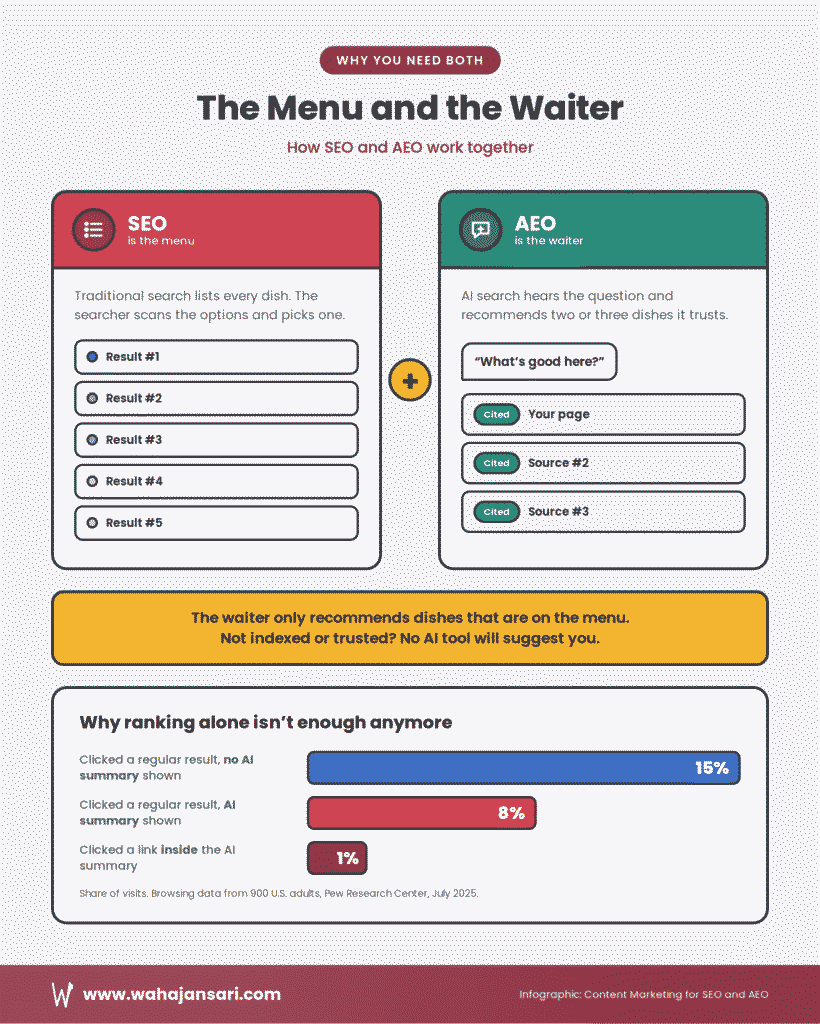
When Pew Research Center tracked real browsing data from 900 U.S. adults, they found that people who saw an AI summary on Google clicked a regular search result in 8% of visits, compared with 15% when there was no AI summary. And the links inside the AI summary itself? Clicked in about 1% of visits.
So ranking still matters. But ranking alone doesn’t guarantee the click anymore.
Now you might be thinking, “Great, so SEO is dead?” No. Not even close. And this is where a lot of people panic in the wrong direction.
Here’s how I like to think about it. Picture a restaurant. Traditional search is the menu: every dish is listed, and the customer picks one. AI search is the waiter: the customer asks “what’s good here?” and the waiter recommends two or three dishes.
You want to be on the menu (SEO). And you want to be the dish the waiter recommends (AEO). But here’s the catch: the waiter only recommends dishes that are actually on the menu. If you’re not indexed, trusted, and findable, no AI tool is going to suggest you.
That’s why you can’t pick one. They feed each other.
SEO vs AEO Content: What Actually Changes?
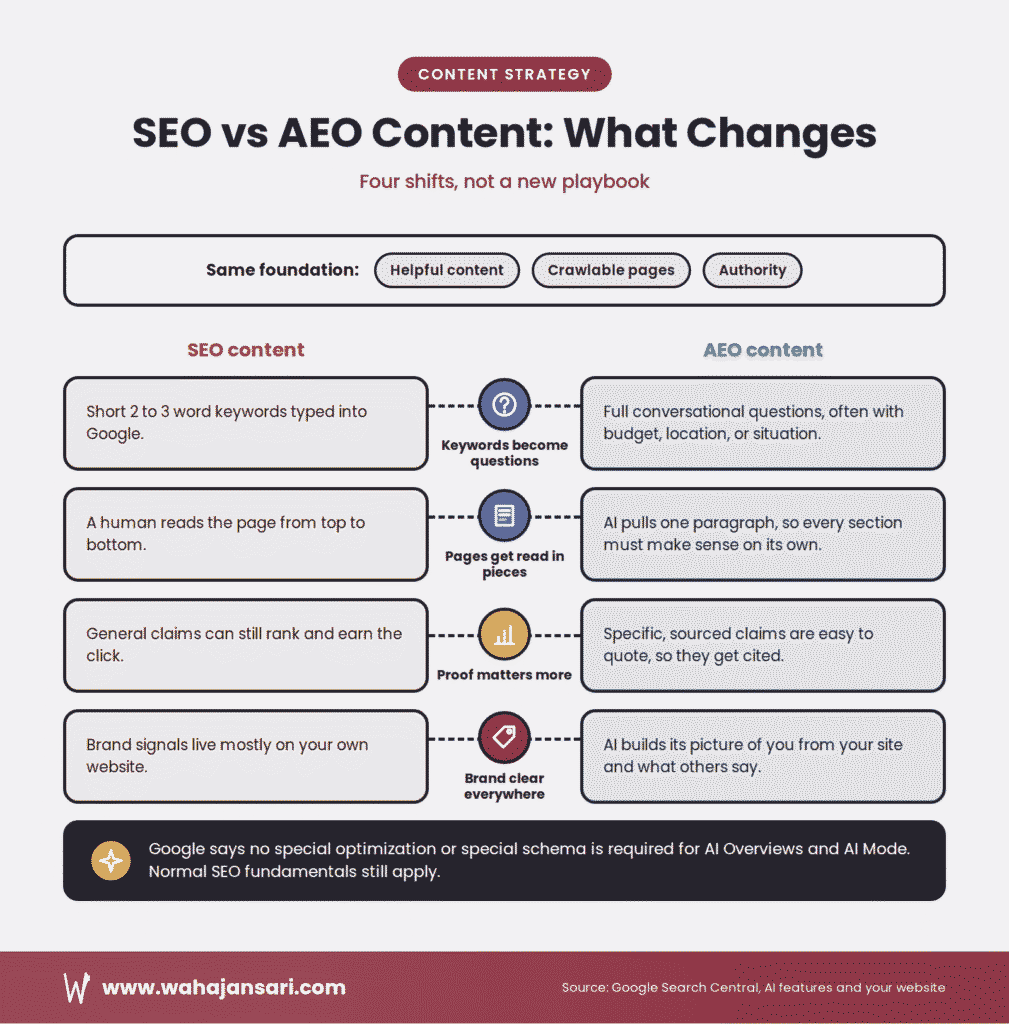
Short answer: SEO content is built to rank a page and earn the click. AEO content is built so an AI tool can lift a clear answer from your page and cite you as the source. The foundation (helpful content, crawlable pages, authority) is the same. The difference is mostly in how you structure, prove, and phrase things.
Google itself says this pretty plainly. Its documentation on AI features states that no special optimization is required for AI Overviews and AI Mode, and that normal SEO fundamentals still apply. It also says there’s no special schema you need to add for them.
So when someone sells you “AEO schema that guarantees AI citations,” be a little suspicious.
But “same foundation” doesn’t mean “zero difference.” Here’s where I see the real shifts:
- Keywords become questions. People type 3 words into Google. They type full sentences into ChatGPT, often with context like their budget, location, or situation.
- Pages get read in pieces. A human reads your post top to bottom. An AI tool often pulls one paragraph. If that paragraph only makes sense with the five paragraphs before it, it’s useless to the AI.
- Proof matters more. A vague claim is easy to skip. A specific, sourced claim is easy to quote.
- Your brand needs to be clear everywhere. AI tools build their picture of your business from your site and from what others say about you.
That’s it. Four shifts. Not a new religion.
The Overlap: One Piece of Content, Two Jobs
Here’s a mistake I see a lot: businesses creating separate “AEO content” next to their “SEO content.” Two blog posts on the same topic. One long and keyword-focused, one short and FAQ-style.
Honestly? I’d never do that. You end up competing with yourself and splitting whatever authority the topic could have built.
Instead, make every piece do both jobs. A good test is to ask two questions about each section you write:
- Would a human scanning this page feel their question got answered? (SEO job)
- If an AI copied just this one section, would it still make complete sense? (AEO job)
If the answer is yes to both, you’re done. If it’s only yes to the first one, you need to tighten the section. Let me show you how in the steps below.
My Experience:
Last year I was working on a cost guide page on in-homecare.co.uk, one of those “how much does home care cost in the UK” explainers that had been live for about three years and never earned a single citation anywhere. The original opened with two warm-up paragraphs about why planning ahead matters. Classic burying the answer.
The rewrite was straightforward. I led the page with a plain hourly cost range for domiciliary care and a weekly range for live-in care, each pulled from current Age UK and Which? Later Life figures with the publication year next to the number. Added a short three-row comparison table for hourly, overnight, and live-in. Pulled a two-sentence quote from one of the Fareham branch managers on how most families actually structure a care package in the first six months, with her name and role under it. Nothing clever. Just numbers someone could verify and a sentence from a real person.
About seven weeks later the page started showing up as a cited source in Perplexity for queries like “live-in care cost UK” and “domiciliary care price per hour.” Gemini picked it up a few weeks after that. Clicks did not jump much, which tracks with what the Pew data in this post already showed, but something more useful happened: enquiries through the booking form started quoting figures back at us. “I read somewhere that live-in care is around £X a week, is that still right?” That was the giveaway. People were landing on the brand through AI answers even when they never clicked the page.
The lesson I took from it was almost embarrassing in hindsight. The content had been ranking fine the whole time. What was missing was anything worth quoting.
How to Build a Content Marketing Strategy for SEO and AEO
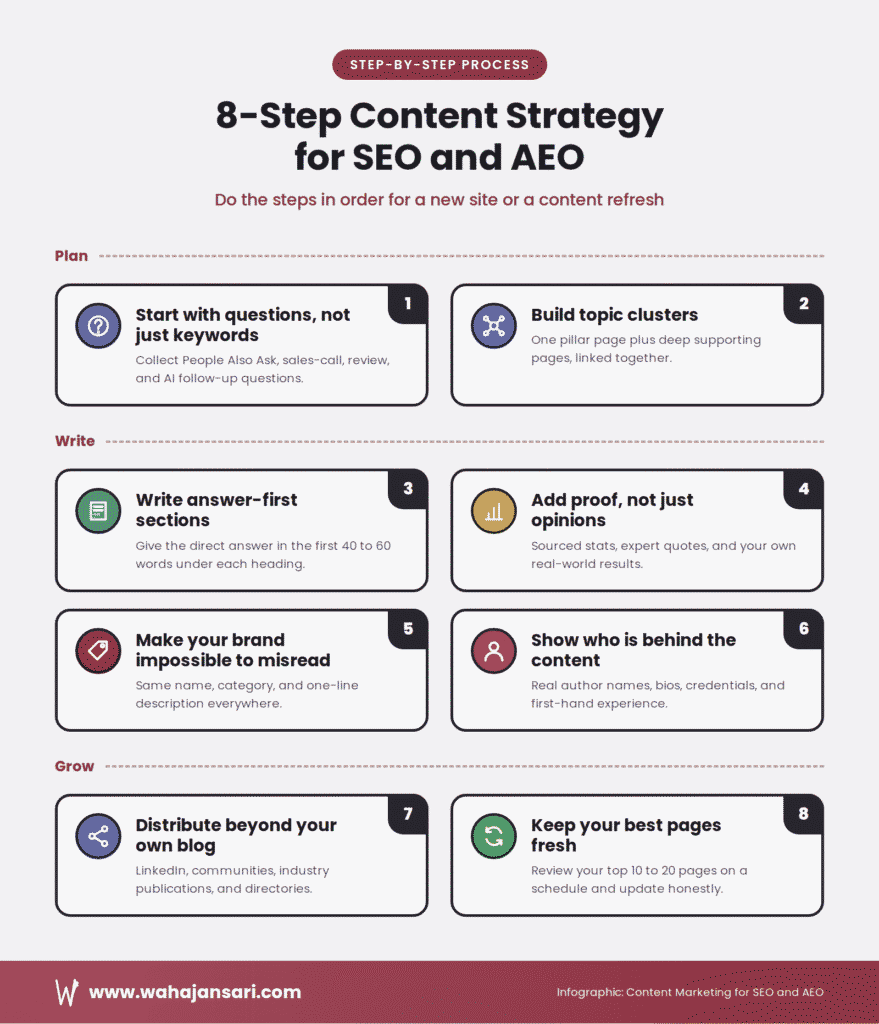
This is the process I’d follow for a new site or a content refresh. Keep it simple, and do the steps in order.
Step 1: Start With Questions, Not Just Keywords
Keyword research is still your starting point. But don’t stop at the head term.
For every main topic, collect the questions people actually ask around it. Good places to look:
- People Also Ask boxes and related searches on Google
- Questions customers ask on sales calls, emails, and WhatsApp
- Reviews of your product and your competitors’ products
- The follow-up questions ChatGPT or Gemini suggest after you ask about your topic
That last one is underrated. Google’s documentation explains that AI Overviews and AI Mode can use a “query fan-out” technique, running several related searches across subtopics to build one answer.
Let me give you an example. Someone asks an AI tool, “What’s the best CRM for a small real estate agency?” Behind the scenes, the tool might look up pricing, ease of use for non-technical agents, integrations with property portals, and reviews. If your content only covers “best real estate CRM” as a keyword, you’re answering one of those sub-questions. Your competitor who covers all five gets pulled in more often.
Step 2: Build Topic Clusters That Cover the Whole Conversation
Once you have your questions, group them.
One strong main page (the pillar) covers the big topic. Supporting pages go deep on the sub-questions. Then you link them together properly so both Google and AI crawlers can see how everything connects. Google’s own AI features guide lists making content easy to find through internal links as one of the fundamentals that still matter.
Think of it like a good shop layout. The main aisle gets people in. The side shelves have the specific thing they need. And the signs make sure nobody gets lost.
One-off blog posts on random topics rarely build this kind of picture. Clusters do.
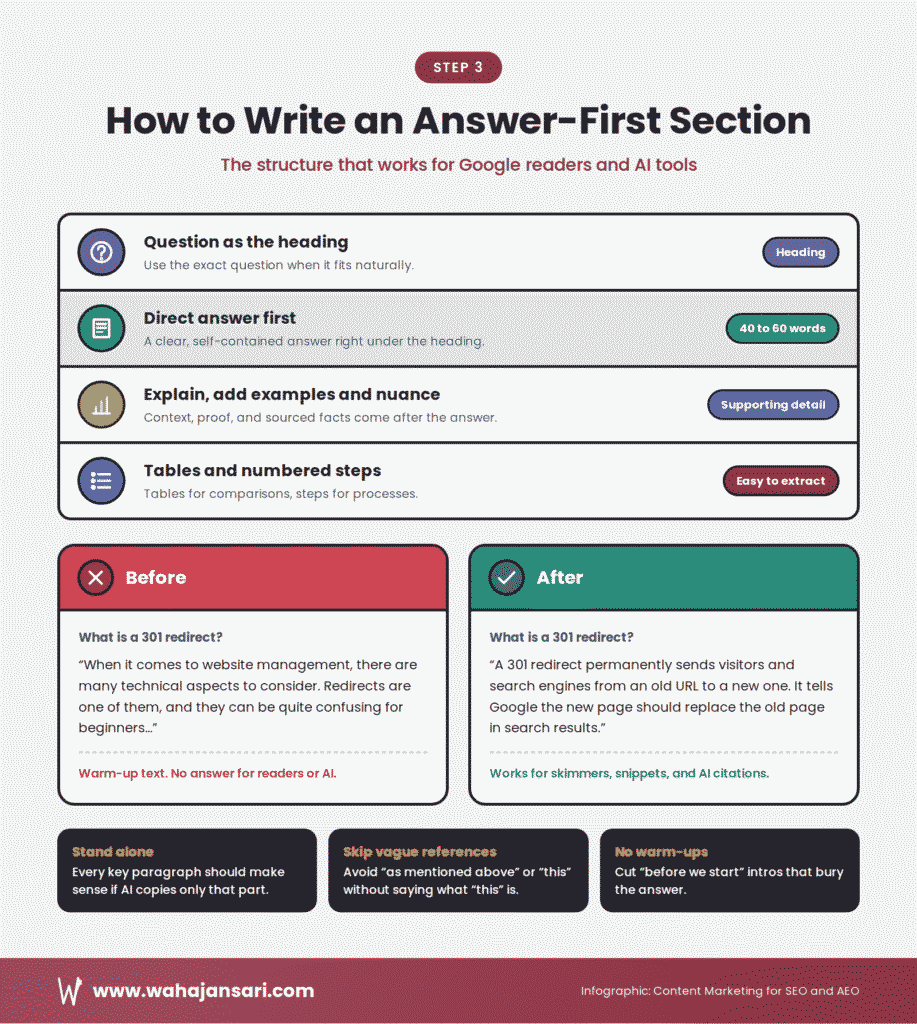
Step 3: Write Answer-First Sections
This is the biggest practical change, and it’s easy to do.
Under each important heading, give the direct answer in the first 40 to 60 words. Then explain, add examples, add nuance. Don’t make the reader (or the AI) dig through a warm-up paragraph to find the point.
Here’s a before and after for the question “What is a 301 redirect?”
Before: “When it comes to website management, there are many technical aspects to consider. Redirects are one of them, and they can be quite confusing for beginners. In this section, we’ll look at one of the most common types.”
After: “A 301 redirect permanently sends visitors and search engines from an old URL to a new one. It tells Google the new page should replace the old page in search results. You’d use it when you change a URL, merge two pages, or move to a new domain.”
See the difference? The “after” version works for a reader in a hurry, works as a featured snippet, and works if an AI tool lifts it word for word.
A few rules that help:
- Make every key paragraph stand on its own. Avoid “as mentioned above” or “this” without saying what “this” is.
- Use the question as the heading when it fits naturally.
- Use tables for comparisons and numbered steps for processes. They’re easy for people to scan and easy for machines to read.
Step 4: Add Proof, Not Just Opinions
If two pages say the same thing, which one would you trust? The one with numbers and a source.
AI systems seem to work the same way. In the research paper that introduced the term Generative Engine Optimization, researchers found that adding citations, quotations from relevant sources, and statistics could boost a source’s visibility in AI-generated answers by up to 40% in their tests. The same paper found that old-school keyword stuffing performed poorly.
So stuffing your keyword 30 times? Doesn’t help with Google, doesn’t help with AI. Now it’s officially bad in two places.
What to add instead:
- Specific numbers with a named, linked source and a date
- A clear quote from a real expert (with their name and role)
- Your own data: survey results, project numbers, before and after results
That last point is where small businesses can win. You might not outrank a giant publisher on authority, but you have something they don’t: your own real-world results. Use them.
[Wahaj: add your experience here if you have one, for example a client post that started getting cited after you added sourced stats or answer-first sections.]
Step 5: Make Your Brand Impossible to Misread
Here’s a question: if someone asked ChatGPT what your business does, would it give the right answer?
Try it. You might be surprised.
AI tools build their understanding of your brand from many places: your homepage, your About page, your Google Business Profile, social profiles, directories, and articles that mention you. If your homepage says “digital growth partner,” your LinkedIn says “marketing agency,” and your directory listing says “web design company,” the AI has to guess. And it often guesses wrong.
Fix it with consistency:
- Use the same business name, category, and one-line description everywhere
- Say clearly what you do, who you serve, and where (if you’re local)
- Use your brand name in your content instead of only “we,” especially on key pages
Boring work. Big payoff.
Step 6: Show Who Is Behind the Content
Google’s guidance on creating helpful, reliable, people-first content asks a simple question: is it obvious to visitors who wrote this content? It also stresses experience and expertise as signs of trust.
So add real author names, short bios, and credentials. Link the author to a proper author page. Share first-hand experience where you have it.
An anonymous “Admin” byline on a medical or finance post in 2026? That’s like a doctor showing up to your appointment wearing a mask and refusing to tell you their name. Technically possible. Not very reassuring.
Step 7: Distribute Beyond Your Own Blog
This is the part most SEO-only content plans skip.
Content marketing was never just “publish and pray.” And for AEO, it matters even more, because AI tools often cross-check what you say against what others say about you.
So repurpose and spread your best pieces:
- Turn key insights into LinkedIn posts or short videos
- Answer real questions in communities where your audience hangs out (genuinely, not with spammy links)
- Pitch your original data or opinions to industry publications
- Keep your profiles on review sites and directories up to date
The goal isn’t backlinks alone. It’s being mentioned, accurately, in more places that matter.
Step 8: Keep Your Best Pages Fresh
AI answers change fast, and outdated content is easy to replace.
Pick your top 10 to 20 pages (the ones that bring traffic or leads) and review them on a schedule. Update stats, replace old screenshots, add new questions people are asking, and fix anything that’s no longer true. Then update the “last updated” date honestly. Only change the date when you actually changed something meaningful.
Refreshing a page that already ranks is usually faster than building a new one from scratch. It’s the cheapest win in this whole list.
Technical Checks Before You Hit Publish
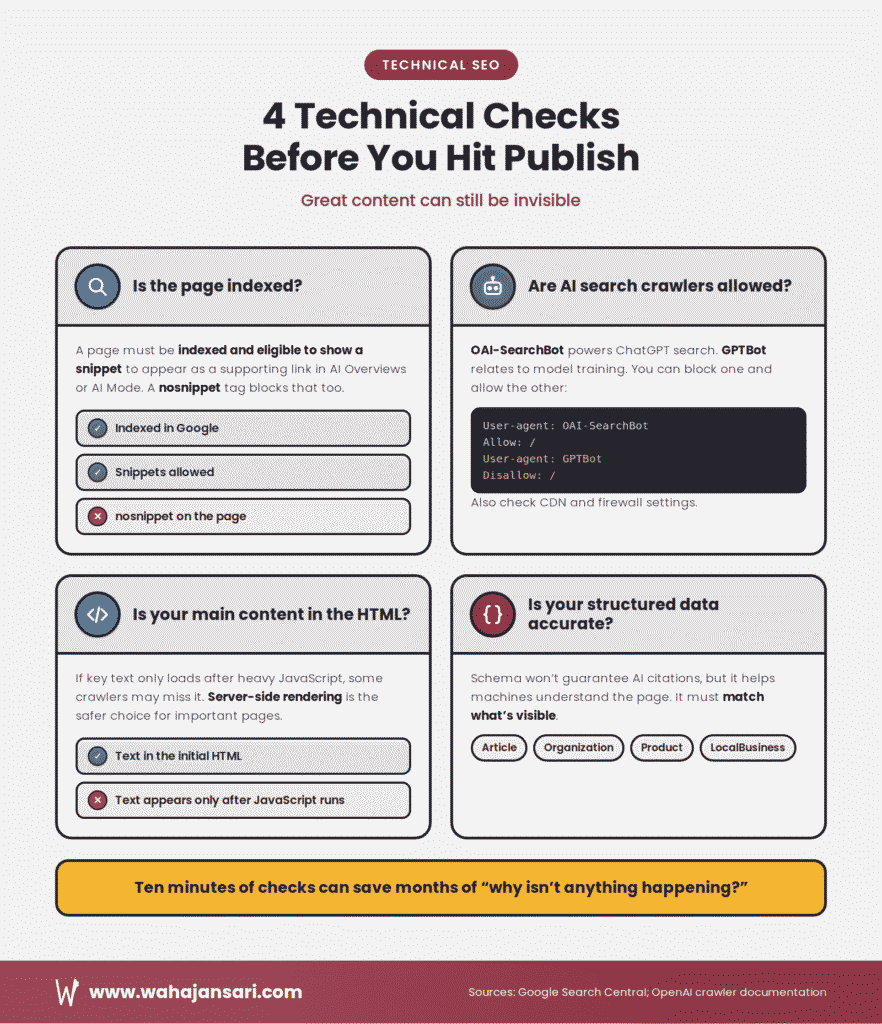
Great content can still be invisible. Before you celebrate, check these:
- Is the page indexed? Google says a page needs to be indexed and eligible to show with a snippet to appear as a supporting link in AI Overviews or AI Mode. If you’ve blocked snippets with nosnippet, you’ve blocked that too.
- Are you accidentally blocking AI search crawlers? OpenAI explains that OAI-SearchBot is the crawler used to surface sites in ChatGPT search, and that it’s separate from GPTBot, which relates to model training. You can block training and still allow search. Check your robots.txt and your CDN or firewall settings, because security tools sometimes block these bots without you knowing.
- Is your main content in the HTML? If key text only loads after heavy JavaScript, some crawlers may not see it properly. Server-side rendering is the safer choice for important pages.
- Is your structured data accurate? Schema doesn’t magically get you into AI answers, but accurate Article, Organization, Product, or LocalBusiness markup helps machines understand your page. Just make sure it matches what’s visible on the page.
Ten minutes of checks can save months of “why isn’t anything happening?”
How to Measure SEO and AEO Content Performance
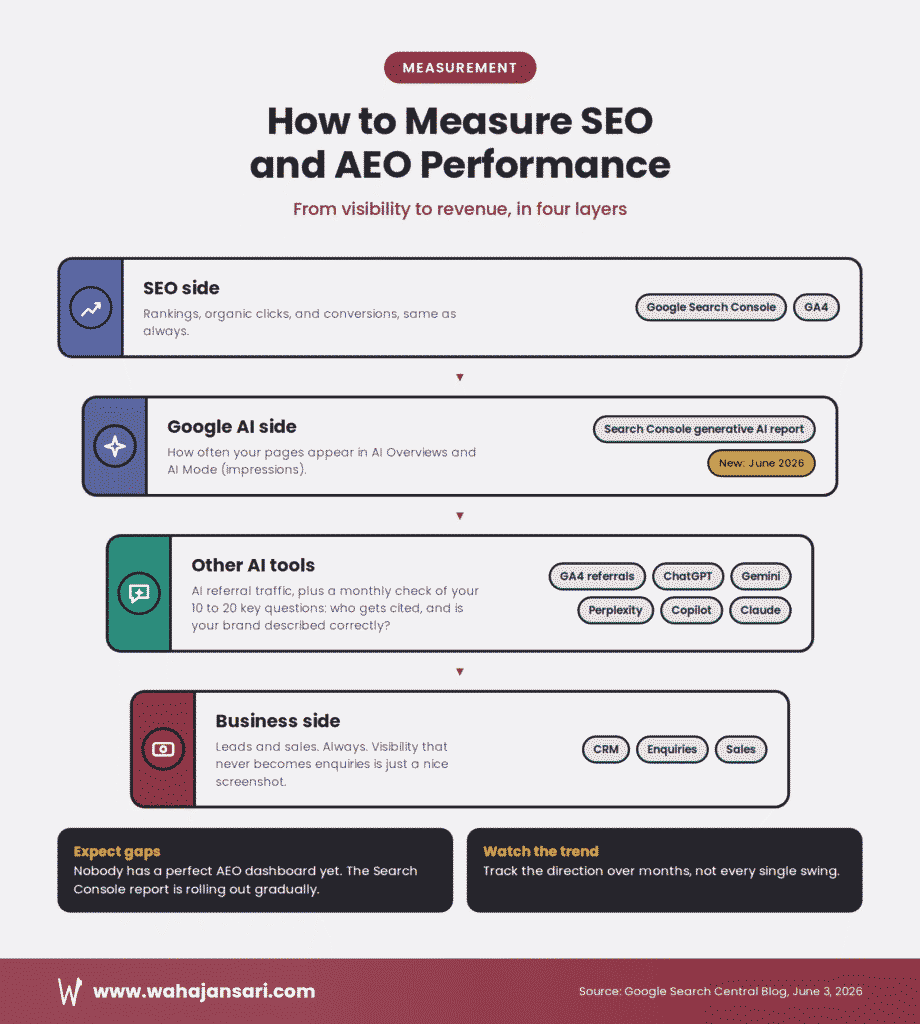
Here’s where AEO used to get frustrating. You’d do all this work and have no idea if it was working.
That’s improving. On June 3, 2026, Google announced new Search Generative AI performance reports in Search Console, which show how often your URLs appear in AI features like AI Overviews and AI Mode, along with pages, devices, and dates. It’s rolling out gradually, so you might not see it in every property yet. And right now it focuses on impressions, so treat it as a visibility signal rather than a full traffic picture.
Here’s the simple measurement setup I’d use:
- SEO side: rankings, organic clicks, and conversions in Google Search Console and GA4, same as always
- Google AI side: the generative AI report in Search Console (if you have access), to see which pages appear in AI features
- Other AI tools: referral traffic from AI platforms in GA4, plus a monthly manual check where you ask ChatGPT, Gemini, Perplexity, Copilot, and Claude your 10 to 20 most important questions and note who gets cited and whether your brand is described correctly
- Business side: leads and sales. Always. Visibility that never turns into enquiries is just a nice screenshot.
Don’t expect a perfect dashboard yet. Nobody has one. Track the trend, not every single swing.
Mistakes I’d Avoid
Quick list, because these come up again and again:
- Writing for robots instead of people. If the content is stiff and stuffed, both Google and readers lose interest. Write for the reader first, then structure it for machines.
- Mass-producing thin AI content. Pumping out 100 generic posts that say what every other page already says won’t make you citable. It just adds noise.
- Burying the answer. Long intros, story-first sections, and “before we start” paragraphs push your actual answer out of reach.
- Ignoring old content. Your best traffic pages quietly go stale while you keep chasing new topics.
- Treating AEO as a one-time project. AI answers shift. Your content plan should be ongoing, just like SEO.
FAQs About Content Marketing for SEO and AEO
Does AEO replace SEO?
No. AEO builds on top of SEO. AI tools usually pull from pages that are crawlable, indexed, and trusted, which is exactly what good SEO gives you. If you drop SEO to “focus on AI,” you remove the foundation AEO depends on.
Do I need separate content for AI search?
Usually not. One well-structured page with answer-first sections, clear proof, and good coverage of related questions can rank in Google and get cited by AI tools. Separate thin pages often split your authority.
What type of content gets cited most in AI answers?
Content that answers a specific question clearly, early, and with proof. Think definitions, step-by-step guides, comparison tables, and pages with original data or sourced statistics. Vague, generic content is the easiest to skip.
How long does it take to see results?
It depends on your site’s authority and how much content you already have. If you already rank well, restructuring existing pages can show results sooner than building new ones. A newer site with low authority will need more time, because both Google and AI tools need reasons to trust it first.
Final Thoughts
If you remember one thing from this post, make it this: you don’t need a separate AEO content plan. You need better content marketing.
Answer real questions. Put the answer first. Back it up with proof. Make your brand clear everywhere. Keep your best pages fresh. Do that consistently and you’ll be on the menu and the dish the waiter recommends.
And if you’re a small business owner reading this and feeling overwhelmed? Start small. Pick your five most important pages, rewrite their key sections to be answer-first, add a few sourced facts, and check your robots.txt. That alone puts you ahead of most of your competitors, who are still debating whether “AEO is real.”
It is. And the best time to start is before your competitors figure that out.
Discover more from Wahaj Ansari
Subscribe to get the latest posts sent to your email.